TL;DR:
- A modern business website depends on performance, usability, and SEO to drive growth beyond just looks. It must be mobile-friendly, reflect a strong brand, and provide clear messaging with effective calls to action. Ongoing audits, strategic updates, and expert guidance are crucial for maintaining relevance and ranking success.
Many UK business owners pour budget into making their website look impressive, only to wonder why it fails to generate enquiries or rank in Google. A beautiful homepage means nothing if visitors can’t find what they need, the site loads slowly on a mobile phone, or search engines can’t read the page structure. Modern business website design is about far more than colours and fonts. It’s a strategic combination of performance, usability, and SEO that turns a passive digital brochure into a genuine growth engine for your business.
Table of Contents
- What defines a modern business website?
- Balancing style and substance: why user experience matters
- Building for SEO: design elements that make a difference
- Must-have features for today’s business websites
- Continuous improvement: keeping your website modern
- Our perspective: why “modern” is always evolving
- Next steps: expert support for your business website
- Frequently asked questions
Key Takeaways
| Point | Details |
|---|---|
| Modern means more than looks | A successful business website combines smart design, usability, and SEO performance, not just visual appeal. |
| User experience drives results | Clear navigation, mobile optimisation, and fast loading boost engagement and conversions. |
| SEO starts with design | Site structure and internal linking are foundational to Google rankings for UK businesses. |
| Regular updates matter | Review and enhance your site continuously to stay competitive and meet evolving user needs. |
What defines a modern business website?
The word “modern” gets thrown around a lot in web design conversations, but it has a very specific meaning when it comes to business performance. A modern site isn’t simply one that looks current. It’s one that works reliably, communicates clearly, and serves both people and search engines effectively.
At the most fundamental level, mobile-friendly and fast-loading sites with a clear hierarchy are the baseline expectation, not a premium feature. Google confirmed mobile-first indexing as standard practice years ago, meaning the mobile version of your site is what gets assessed for ranking purposes. If your site is slow, broken, or cluttered on a phone, you’re already losing ground before a visitor has read a single word.
Beyond performance, a modern business website must reflect a coherent brand identity. That means consistent typography, a cohesive colour palette, and imagery that represents your business authentically rather than relying on generic stock photos. Visitors form an opinion about your credibility within seconds of landing on a page. A visually fragmented or dated site signals that the business behind it may not be trustworthy or professional.
Content is equally important. Modern websites carry clear, purposeful messaging that speaks directly to the target customer’s needs. Vague tag lines and walls of corporate text no longer cut it. Strong calls to action, whether that’s booking a call, requesting a quote, or downloading a guide, must appear at the right moments throughout the user journey.
“A modern business website is not a one-time project. It’s an ongoing investment in your reputation, visibility, and revenue.”
Accessibility and security round out the picture. An SSL certificate (the padlock in the browser bar) is a ranking signal and a trust signal. Accessibility features, such as clear font sizes, sufficient colour contrast, and keyboard-navigable menus, ensure your site works for every visitor, and help you comply with UK equality legislation.
Balancing style and substance: why user experience matters
Style without substance is one of the most common and costly mistakes in business website design. A site can look spectacular in a design agency portfolio and still fail completely when real customers use it. Websites that balance aesthetics with usability consistently outperform visually led sites on both SEO metrics and conversion rates.
User experience, often shortened to UX, describes how easy and satisfying it is for a person to navigate and use your website. The pitfalls that destroy UX are remarkably consistent across industries:
- Slow loading speeds: A page that takes more than three seconds to load loses a significant proportion of visitors before they’ve even seen your content.
- Confusing navigation: Menus with too many options, unclear labels, or hidden pages force visitors to work too hard. Most won’t bother.
- Visual clutter: Competing colours, too many fonts, excessive pop-ups, and dense blocks of text make a page feel overwhelming and untrustworthy.
- No clear next step: If a visitor can’t immediately see what to do next, they leave. Lack of prominent calls to action is one of the biggest conversion killers.
- Poor mobile experience: Buttons too small to tap, text that requires zooming, or images that spill off the screen are all deal-breakers on mobile.
Here’s a simple comparison to illustrate the difference between a high-performing and a low-performing approach:
| Design approach | User outcome | Business outcome |
|---|---|---|
| Clear navigation, fast load, mobile-friendly | Visitor finds what they need quickly | More enquiries and lower bounce rate |
| Complex menus, slow pages, cluttered layout | Visitor gets frustrated and leaves | Lost leads and poor rankings |
| Consistent branding, strong calls to action | Visitor feels confident and takes action | Higher conversion rate |
| Outdated visuals, broken forms, no SSL | Visitor doubts credibility | Damaged reputation and trust |
Pro Tip: Run your current website through Google’s free PageSpeed Insights tool. It will show you exactly where your site is losing performance and give you a prioritised list of fixes. Even simple design upgrades to loading speed and layout can have a measurable impact on enquiries within weeks.
A well-structured user journey doesn’t happen by accident. It requires deliberate planning: mapping out the pages a potential customer will visit, the questions they’ll have at each stage, and the precise moment they’re most likely to take action. Think of it as designing a path, not just a set of rooms.

Building for SEO: design elements that make a difference
A visually appealing, user-friendly website is only part of what you need. The structural and technical decisions you make during the design process have a direct and lasting impact on how Google ranks your site. Website structure and internal linking are central to effective SEO, and both are largely determined at the design stage.
Here are the key design decisions that influence your search rankings:
- Site hierarchy: Organise your pages logically, with your most important service or product pages sitting close to the homepage. Deep, buried pages receive less ranking authority.
- Internal linking: Connect related pages together using descriptive anchor text. This helps Google understand the relationship between your content and distributes ranking power across your site. Explore proven SEO optimisation strategies to understand how internal links support your wider search strategy.
- Page load speed: Google uses Core Web Vitals, a set of speed and stability metrics, as ranking factors. Compress images, use a reliable hosting provider, and minimise unnecessary code.
- Mobile optimisation: Google evaluates the mobile version of your site first. A design that works beautifully on desktop but poorly on mobile will underperform in search results.
- Descriptive URLs and page titles: Clean, keyword-relevant URLs (for example, "/services/seo-audit
rather than/page?id=23`) help both users and search engines understand what a page is about. - Content structure: Use heading tags (H1, H2, H3) logically to organise page content. This creates a readable hierarchy for visitors and gives search engines clear signals about what each page covers.
The SEO impact of web design decisions is frequently underestimated. Many businesses commission a redesign focused purely on aesthetics, and inadvertently strip out the very elements that were driving their organic traffic. If you’re planning a redesign, an SEO review before and after is not optional. It’s essential.
Key statistic: Google’s mobile-first indexing means that if your mobile site is slower or less complete than your desktop version, your rankings across all devices will suffer. This single factor affects the majority of UK SME websites.
| Design element | SEO benefit |
|---|---|
| Fast page load speed | Improves Core Web Vitals scores |
| Clear site hierarchy | Helps Google crawl and index pages efficiently |
| Descriptive internal links | Distributes ranking authority across the site |
| Mobile-responsive layout | Meets Google’s mobile-first indexing standard |
| Logical URL structure | Improves crawlability and click-through rates |
Must-have features for today’s business websites
Technical foundations and SEO-friendly structures set the stage. But the specific features you include on your site are what ultimately persuade a hesitant visitor to become a paying customer. Contact forms, team profiles, case studies, and testimonials demonstrably increase credibility and trust, which is particularly important for service-based businesses where the relationship matters as much as the price.
Here’s what your business website should include in 2026:
- Contact forms: Make it effortless to get in touch. A form on every key page, not just a dedicated contact page, removes friction and increases the chances of an enquiry.
- Customer testimonials: Real quotes from real clients, ideally with names and photos, carry far more weight than anything you say about yourself.
- Case studies: Show your work in context. A brief breakdown of the problem, your approach, and the outcome builds confidence in your capability.
- Team bios: People buy from people. A short profile with a genuine photo of the person or team they’ll be working with makes a business feel approachable and trustworthy.
- Service pages with clear benefits: Each service you offer deserves its own dedicated page, written to address the customer’s question of “what’s in it for me?”
- Live chat or chatbot: For businesses with higher enquiry volumes, live chat can significantly increase conversion rates by answering questions in real time.
- Social media integration: Links to active social profiles and embedded review feeds (such as Google reviews) add further layers of social proof.
- Legal and compliance pages: Privacy policy, cookie consent, and terms of service are legal requirements for UK businesses under GDPR. They also signal professionalism.
Pro Tip: Follow a clear step-by-step optimisation process to audit what your site currently has and identify the gaps. Prioritise features that directly address the questions your customers are asking before they make a purchase decision.
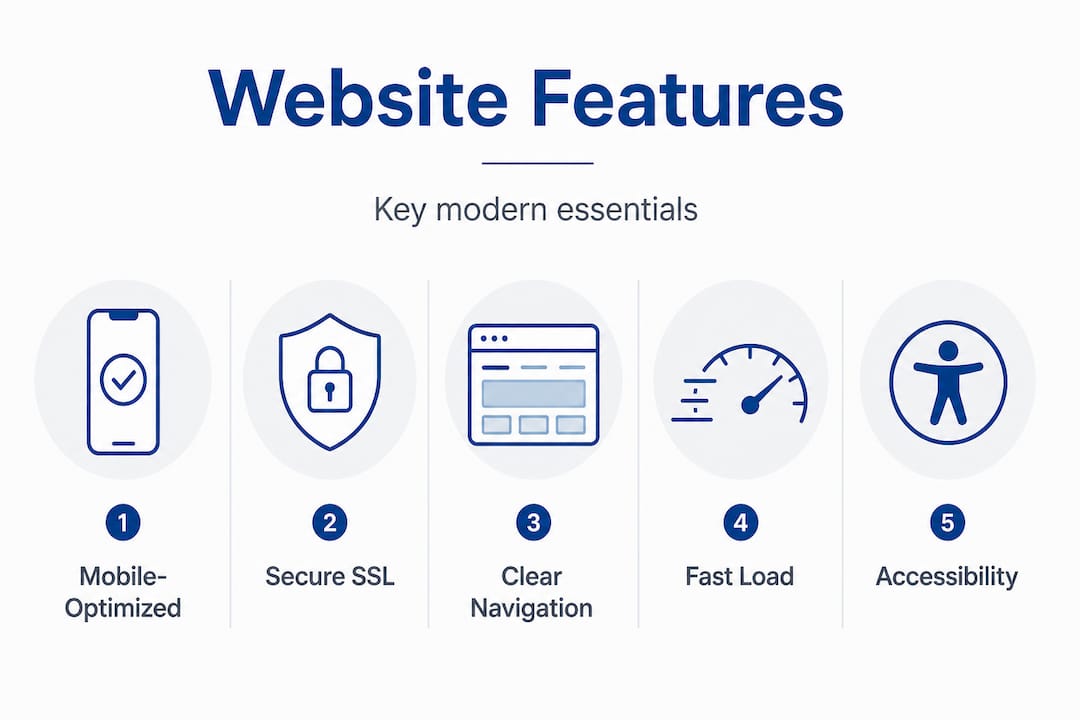
Accessibility deserves special mention. The Web Content Accessibility Guidelines (WCAG) set out the standards for making websites usable for people with disabilities. In the UK, the Equality Act 2010 means failing to provide an accessible website could expose your business to legal risk. Beyond compliance, accessible design simply produces cleaner, clearer websites that work better for everyone.
Continuous improvement: keeping your website modern
Building a strong website is not the finish line. It’s the starting point. The businesses that consistently outperform their competitors online are those that treat their website as a living asset rather than a completed project. Regular audits, user feedback, and iterative updates are what keep a business website performing at its best.
Here’s a practical approach to ongoing website improvement:
- Monthly performance checks: Review your Google Analytics data monthly. Look for pages with high bounce rates, unexpected drops in traffic, or low conversion rates. These are your warning signals.
- Quarterly content reviews: Refresh outdated statistics, update case studies with recent results, and add new blog posts or service information that reflects what customers are currently asking about.
- Bi-annual technical audits: Check for broken links, crawl errors, slow-loading images, and outdated plugins. Small technical issues accumulate quietly and erode your rankings over time.
- Client and visitor feedback: Ask customers directly about their experience on your site. A short survey or a post-purchase question can surface usability problems that analytics alone won’t reveal.
- Competitor monitoring: Review your main competitors’ websites every six months. Note what they’re doing differently and whether there are gaps you could fill or improvements worth adopting.
“The most dangerous assumption in website management is believing your site is ‘done.’ Your competitors aren’t standing still, and neither are your customers’ expectations.”
The good news is that continual improvement doesn’t require a full redesign every couple of years. Most meaningful gains come from targeted design upgrades: improving a single page’s layout, updating imagery, tightening the copy on a key service page, or fixing a slow-loading hero image. Small, deliberate changes compound over time into significant competitive advantages.
Our perspective: why “modern” is always evolving
Here’s a truth most web design conversations skip past: there is no such thing as a finished, permanently modern website. The term “modern” is a moving target, and what satisfies visitors and search engines in 2026 will need revisiting in 2028. That’s not a problem. It’s just how digital works.
Where UK SMEs get into real trouble is by treating a website launch as a one-off investment, then neglecting it for three or four years. By that point, the site has drifted out of alignment with Google’s ranking expectations, visitor behaviour has shifted, and the business has probably changed too. Catching up requires far more effort and budget than staying current would have.
The businesses I’ve seen generate the best long-term results from their websites share a common trait: they resist chasing every design trend and instead focus on fundamentals. Fast load speeds, clear messaging, logical structure, and consistent content updates. These are not glamorous, but they are what compound into rankings, traffic, and revenue.
Understanding website structure pitfalls that quietly hold back rankings is far more valuable than a superficial redesign. Simplicity and strategy, applied consistently, beat trend-chasing every time.
Next steps: expert support for your business website
Building or improving a business website involves dozens of interconnected decisions, and getting even a few of them wrong can cost you rankings, leads, and revenue. Professional guidance removes the guesswork and gets results faster.
If you’re ready to take your website seriously, explore the business web design service built around performance, SEO, and user experience from the ground up. For a deeper understanding of how design and search work together, the SEO website design guide covers exactly how strategic decisions at the design stage translate into better rankings and more enquiries. Every project starts with a conversation, so get in touch to discuss your goals and find out what’s possible for your business.
Frequently asked questions
How often should I refresh my business website design?
A light review every six to twelve months keeps your site current and performing well, with a fuller redesign every three to five years or whenever your business significantly changes. Iterative updates and regular audits are far more effective than leaving a site untouched for years.
Which features are essential on a business website?
Contact forms, testimonials, case studies, clear service listings, and strong calls to action are the core building blocks. These elements build the trust and confidence a visitor needs before they’ll make an enquiry or purchase.
Does mobile optimisation really affect my Google rankings?
Yes, absolutely. Google’s mobile-first indexing means your mobile experience is what Google evaluates for ranking purposes, so a site that performs poorly on phone will rank worse across all devices. Mobile-friendly and fast-loading design is non-negotiable for any business that wants visibility in search.
How can I tell if my current website structure is hurting my SEO?
If visitors leave quickly without exploring further, or your rankings have dropped without an obvious cause, your structure could be at fault. Poor website structure affects both how easily Google can crawl your site and how confidently visitors navigate it.
Why is ongoing improvement important for my business website?
Continuous improvements keep your site aligned with Google’s evolving ranking criteria and your customers’ changing expectations. Without regular attention, even a well-built site will gradually lose ground to competitors who are actively investing in theirs.