TL;DR:
- Google Maps rankings are influenced by relevance, prominence, and behavioral signals like interactions.
- Consistent profile management, fresh photos, reviews, and engagement are key to improving visibility.
- Ongoing, authentic effort beats one-time tactics; measurable results typically appear within a few months.
Your business is listed on Google Maps, but when a nearby customer searches for what you offer, you’re buried on page two, invisible while your competitors take the calls, the clicks, and the footfall. It’s a frustrating position, and far more common than most UK business owners realise. Google Maps visibility directly influences how many people walk through your door or pick up the phone, so improving your ranking isn’t just a marketing exercise, it’s a revenue decision. This article walks you through everything from understanding the ranking factors to measuring your progress.
Table of Contents
- Understanding how Google Maps rankings really work
- Preparing your business for Google Maps SEO success
- Step-by-step: Optimising and managing your Google Maps presence
- Troubleshooting common Google Maps SEO mistakes
- Measuring your progress and what to expect
- The hidden power of consistency and real engagement
- Ready to thrive on Google Maps? Get expert support
- Frequently asked questions
Key Takeaways
| Point | Details |
|---|---|
| Engagement is key | Interactions and regular updates now matter more than sheer quantity of reviews or citations. |
| Avoid shortcuts | Sudden spikes in reviews or buying citations can trigger penalties from Google’s algorithms. |
| Consistency wins | Steady, genuine activity and profile completeness lead to sustainable Google Maps ranking improvements. |
| Track real results | Monitor clicks, calls, and website visits—not just rankings—to measure progress. |
Understanding how Google Maps rankings really work
Before tackling improvements, it helps to unpick which factors actually drive rankings on Google Maps in 2026.
Google uses three core signals to decide which businesses appear in the local “map pack” (the top three results shown on a map). These are proximity (how close the business is to the searcher), relevance (how well your profile matches what’s being searched), and prominence (how well-known and trusted your business appears online). Most business owners focus only on proximity and assume location is destiny. It isn’t.
Relevance and prominence are where you have real control, and both are increasingly driven by behavioural signals. Things like how often users click on your listing, whether they call from Google Maps, how many photos get viewed, and how regularly people interact with your profile all feed into how Google judges your prominence. Understanding the importance of Google Business Profile is the starting point for any serious local SEO strategy.
Key factors that influence your Google Maps ranking include:
- Engagement rate: clicks to your website, calls made, and direction requests from your listing
- Review signals: recency, volume, and the quality of your responses
- Photo activity: freshness of uploaded images and how often they’re viewed
- Profile completeness: categories, services, hours, and business description
- Behavioural patterns: how users interact with your listing versus competitors
According to Google’s own data, businesses with complete profiles receive 70% more location visits than those with incomplete ones. That single statistic makes the case for thorough, consistent profile management better than anything else.
One of the most significant misconceptions still circulating is that amassing hundreds of citations (mentions of your business name, address, and phone number across directories) is the key to ranking well. That was true several years ago. Today, Google’s AI-driven systems reward real behavioural signals over citation volume. Engagement, not quantity, is the measure that matters.
Preparing your business for Google Maps SEO success
With a clearer understanding of what matters, let’s make sure you have the right building blocks in place for success.
The single most important first step is claiming and verifying your Google Business Profile (GBP). If you haven’t done this, a competitor could in theory claim it themselves, or Google might populate it with incorrect information pulled from third-party sources. Verification is straightforward and usually takes a few days by postcard or phone.
Once verified, your priority is ensuring your NAP (Name, Address, Phone number) is consistent across every platform where your business appears. That means your website, Facebook, Yelp, TripAdvisor, Yell, and any other directory. Even small discrepancies, like “St.” versus “Street” or a slightly different phone number format, can introduce confusion. Google’s AI actively uses citations to validate your business as a real entity, and as AI boosts entity validation via citation cross-referencing, consistency has never mattered more. You can read more about this process in our guide on optimising your Google Business Profile.
| Asset | What to prepare | Why it matters |
|---|---|---|
| Google Business Profile | Claim, verify, and complete every field | Core ranking signal |
| Business photos | Interior, exterior, team, products | Drives engagement and clicks |
| Primary category | Choose the most specific category available | Directly affects search relevance |
| Secondary categories | Add up to 9 additional categories | Broadens your search visibility |
| Website link | Link to a relevant landing page, not just your homepage | Improves trust and click-through |
| Opening hours | Include special holiday hours | Reduces bounce from incorrect information |
Pro Tip: Use an AI writing assistant or a tool like ChatGPT to cross-check your business name and address across directories. Paste your NAP into the prompt and ask it to identify variations or inconsistencies. It’s a surprisingly fast way to spot missing listings before they become a problem.
Step-by-step: Optimising and managing your Google Maps presence
Once your basics are set up, these actions make the difference between a neglected and a top-performing Maps listing.
-
Update your profile information regularly. Google treats activity as a trust signal. Add new services, update your description seasonally, and check that your hours are accurate. A profile that hasn’t been touched in six months tells Google your business may not be actively managed.
-
Add fresh photos every week. Listings with recent, high-quality photos consistently outperform those with outdated or stock imagery. A quick photo of your workspace, a finished project, or your team in action takes minutes to upload and can meaningfully increase the number of people who view your profile.
-
Write and publish Google Posts. These are short updates that appear directly on your listing in search results. Use them to promote offers, announce events, or share news. Posts expire after seven days, so weekly publishing keeps your listing looking active.
-
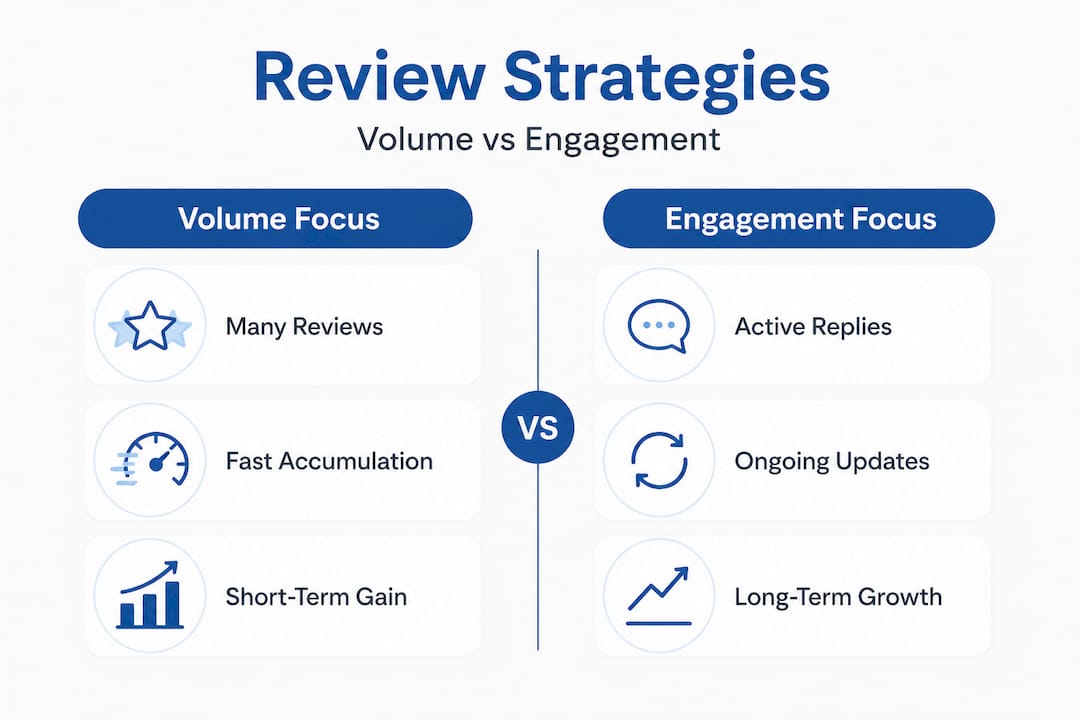
Encourage reviews at a natural, steady pace. Ask happy customers to leave a review after each job or visit. Send a polite follow-up message with a direct link to your Google review page. Spread this activity consistently over time rather than in short bursts. According to local SEO experts in 2026, avoiding spikes in review activity is critical because sudden surges trigger Google’s spam filters.
-
Reply to every single review. Positive or negative, a thoughtful reply shows that a real person is behind the business. It also gives you a natural opportunity to include relevant keywords in your response without stuffing them awkwardly into your profile.
| Strategy | Volume-focused reviews | Engagement-focused reviews |
|---|---|---|
| Goal | Accumulate as many reviews as possible | Build a steady, authentic review history |
| Risk | Triggers spam filters, filtered reviews | Low risk, sustainable |
| Google’s response | May penalise or suppress listing | Rewards with higher prominence |
| Customer trust | Can appear artificial | Feels credible and trustworthy |
| Recommended in 2026 | No | Yes |
For more detailed actions you can take to strengthen your listing technically, explore our guide on advanced technical SEO tactics for GBP. If you’d rather hand the ongoing management to a specialist, our GBP optimisation services cover everything from profile setup to ongoing posting.
Pro Tip: Inside your Google Business Profile dashboard, the “Insights” section shows which photos and posts generate the most views and engagement. Check it fortnightly and double down on whatever is working.
Troubleshooting common Google Maps SEO mistakes
Even good intentions can backfire. Let’s sidestep the most common errors that sabotage your results.
“Sudden spikes in review activity remain one of the most reliable ways to trigger Google’s spam filters in 2026. A business that receives 40 reviews in a week after averaging two a month will almost certainly see those reviews filtered or the listing flagged.” — Local SEO community consensus on avoiding review spikes
The five most damaging mistakes UK SMEs make with their Google Maps presence, and how to fix them:
-
Inconsistent NAP information: Your address appears differently on your website versus your GBP. Fix it by auditing every directory and updating them to match exactly. Use a tool like BrightLocal or Whitespark to find every listing.
-
Review spikes: You ask your entire client list for reviews in one weekend. Fix it by spacing review requests out over weeks and months, making them part of your routine post-sale process.
-
No replies to reviews or Q&A: Unanswered questions and reviews make your listing look abandoned. Fix it by setting a calendar reminder to check your GBP every Monday morning.
-
Wrong primary category: You’ve chosen a broad category like “Restaurant” when “Indian Restaurant” or “Vegan Café” would capture more relevant searches. Fix it by revisiting your category selection and choosing the most specific option available.
-
Over-optimised profile stuffed with keywords: Forcing keywords unnaturally into your business name or description can trigger a suspension. Fix it by writing your description as you would speak to a customer, clearly and honestly. Our GBP management services help businesses avoid these pitfalls from the outset.
Measuring your progress and what to expect
With your listing optimised, measurement is what confirms your efforts are moving the needle.
Google provides free insights directly within your GBP dashboard. These show you how many people viewed your listing, how many clicked to your website, how many requested directions, and how many called you directly from Maps. These are your core behavioural metrics. And as behavioural metrics now outweigh citation volume in Google’s ranking signals, tracking them regularly tells you far more than simply counting your directory listings.
Here’s how to set up a simple tracking routine:
- Log in to your Google Business Profile dashboard and note your current metrics: views, clicks, calls, and direction requests.
- Record these figures in a simple spreadsheet on the first of each month.
- Set a monthly reminder to compare your current figures to baseline.
- After 90 days, review which actions correlated with increases in calls or direction requests.
- Double down on the tactics that produced the strongest engagement.
| Metric | Baseline | Month 1 | Month 3 |
|---|---|---|---|
| Profile views | 220 | 290 | 410 |
| Website clicks | 35 | 52 | 89 |
| Direction requests | 12 | 19 | 34 |
| Phone calls from Maps | 8 | 14 | 27 |
| Reviews received | 6 | 9 | 18 |
For most UK SMEs, meaningful movement in these numbers typically begins within four to eight weeks of consistent optimisation. By the three-month mark, businesses that engage actively with their profile, post regularly, and gather reviews steadily often see direction requests and calls double. You can read real examples in our UK SME SEO case studies to benchmark what’s achievable for your sector.
Realistic expectations matter here. Google Maps SEO is not a one-time fix. It rewards consistent behaviour over time. A business that optimises its profile and then ignores it for three months will slide back down, because competitors who keep engaging will signal more activity to Google’s algorithm.
The hidden power of consistency and real engagement
Here’s a perspective that doesn’t get said enough: most UK business owners who struggle with Google Maps visibility aren’t losing because they lack technical knowledge. They’re losing because they’re inconsistent.
The old approach to local SEO was built on one-time actions. Build your citations, gather a load of reviews, and wait. That model is functionally dead. Google’s AI systems now look for patterns of genuine, ongoing engagement. A business that posts weekly, responds to every review within 24 hours, adds fresh photos consistently, and answers Q&A promptly is sending a stream of positive engagement signals that no one-time “optimisation blast” can replicate.
There’s also something worth saying about authenticity. When we work with clients at Gregg King, we often find that the businesses ranking at the top of local Maps results aren’t the biggest or the most technically sophisticated. They’re the ones whose customers genuinely like them and say so regularly. Google is, in effect, learning to mirror human trust signals. The engagement that outperforms citations is the kind that comes from real customer relationships, not manufactured signals.
Shortcuts like citation bombs or incentivised review campaigns might produce a short-term uptick. But the real cost is the risk of penalties, filtered reviews, or a suspended listing, all of which take significant time and effort to recover from. We’ve seen what sustainable SEO success looks like across dozens of UK businesses, and it always comes back to doing the straightforward things reliably over a long period of time.
Pro Tip: After every completed job, simply ask your customer: “Would you mind leaving us a quick Google review? It really helps us.” Do this consistently, one customer at a time, and your review growth will be organic, credible, and penalty-proof.
Ready to thrive on Google Maps? Get expert support
Knowing what to do and having the time and expertise to do it consistently are two very different things. Most business owners are already stretched, and Google Maps SEO rewards exactly the kind of ongoing attention that’s hardest to maintain when you’re running a business day to day.
At Gregg King, we specialise in helping UK SMEs cut through the complexity of local SEO with clear, practical strategies that deliver measurable results. Whether you’re starting from scratch or looking to reclaim rankings you’ve lost, our GBP optimisation for local SEO service covers everything from profile setup to ongoing management. You can also explore our full range of GBP optimisation services and, if your website needs work alongside your Maps presence, our SEO and website design services bring both together under one roof. Book a free consultation today and find out exactly where your listing stands.
Frequently asked questions
How long does it take to see results from Google Maps SEO?
Most SMEs notice measurable changes in 4 to 12 weeks when they engage consistently with their profile. Tracking behavioural metrics like calls and direction requests gives you the clearest picture of early progress.
Do I need a website to rank on Google Maps?
A website is strongly recommended, as it adds authority and helps Google validate your business as a legitimate entity. AI-driven entity validation means a linked, well-structured website genuinely strengthens your Maps ranking potential.
Is buying fake reviews or citations worth it?
No. Google’s AI is highly effective at detecting artificial patterns, and sudden review spikes often result in filtered reviews, suppressed listings, or a suspended profile that can take months to recover.
What’s the most important action I can take each week?
Update your profile with a post or fresh photo, and ask one or two real customers for an honest review. Steady engagement over time outperforms any single burst of activity and keeps your listing signalling genuine activity to Google.