
TL;DR:
- Local SEO success relies on targeting specific location, service, and urgency keywords naturally.
- Using combined tools and real client language helps identify valuable local search terms.
- Consistent integration of keywords across website and Google profiles boosts local visibility.
You could be the best plumber in Manchester, the most reliable accountant in Leeds, or the sharpest solicitor in Birmingham, and still be practically invisible online. That is the frustrating reality for thousands of UK service businesses: excellent work, poor visibility. The gap between you and your next client is often not talent or price. It is keyword research. Knowing exactly which local search terms your ideal clients use, and weaving them into your website and Google Business Profile, is what separates businesses that get found from those that get ignored. This guide walks you through the whole process, step by step.
Table of Contents
- Understanding the local SEO keyword landscape
- Essential local keyword research tools and sources
- Step-by-step: Building your local keyword set
- Common mistakes and how to avoid them
- Putting keywords to work across your website and Google profiles
- Why local keyword research is more than just SEO data
- Ready to accelerate your local visibility?
- Frequently asked questions
Key Takeaways
| Point | Details |
|---|---|
| Match real search intent | Target keywords combining service, location, and urgency to capture what local clients actually type. |
| Validate with core phrases | Check keywords without location first, then add local modifiers for better optimisation. |
| Keep keywords natural | Avoid stuffing location terms—use locally relevant language that feels authentic for humans and search engines. |
| Synchronise across profiles | Make sure keywords appear both on your website and your Google Business Profile for unified local SEO impact. |
Understanding the local SEO keyword landscape
Local SEO keyword research works differently from standard SEO. You are not just trying to rank for broad terms like “accountant” or “plumber.” You are targeting people in a specific place, with a specific need, often at a specific moment. That combination of geography, service, and urgency is what local intent is all about.
Local keywords fall into two broad categories: explicit and implicit.
Explicit local keywords spell out the location directly. Think “boiler repair Sheffield,” “HR consultant Warrington,” or “wedding photographer Cheshire.” The user has told Google exactly where they are or where they want the service.
Implicit local keywords rely on Google to infer location. “Boiler repair near me” is the classic example. The user has not named a town, but Google knows their location from their device and serves up local results accordingly.
Here is a quick comparison of the two types:
| Keyword type | Example | When it works best |
|---|---|---|
| Explicit | “solicitor in Leeds” | Desktop searches, planned decisions |
| Implicit | “solicitor near me” | Mobile searches, urgent needs |
| Service only | “family solicitor” | Broad awareness, early research stage |
| Service + intent | “emergency plumber open now” | High-urgency, ready-to-buy moments |
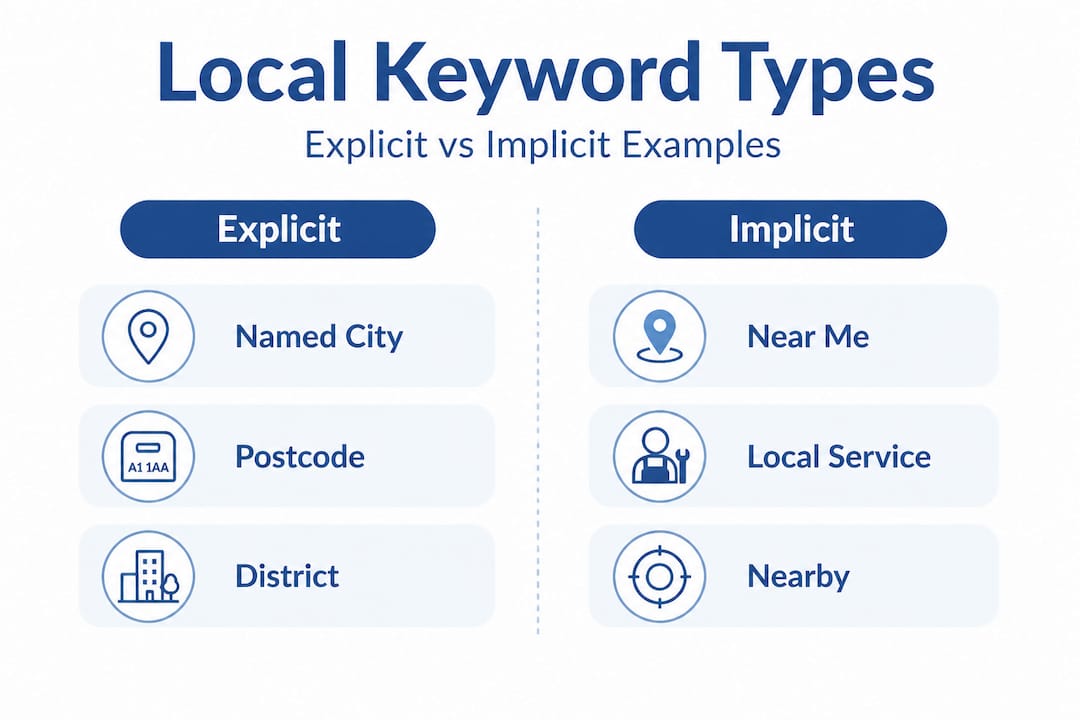
For service businesses, the real goldmine sits at the intersection of all three elements: service, location, and urgency or comparison intent. Someone searching “best emergency electrician in Liverpool” is not browsing. They are ready to call. Prioritise those terms in your keyword strategy.
Understanding these categories also matters because you need to think about local SEO ranking tips differently depending on the intent behind each keyword. A page targeting “emergency plumber Warrington” needs a very different structure and tone from one targeting “what does a boiler service include.”
Pro Tip: Do not try to cram multiple town names into a single paragraph to “cover your bases.” Google recognises keyword stuffing and it can actively damage your rankings. Write naturally, and create separate, genuinely useful pages for each significant location you serve.
One more thing worth flagging: boosting local business visibility is not just about your website. Local keywords need to appear consistently across every digital touchpoint you own, including your Google Business Profile, your service descriptions, and even your review responses. Think of your keyword strategy as a joined-up system, not a single-page exercise.

Essential local keyword research tools and sources
Knowing what to look for is one thing. Finding and validating specific keywords is another. Fortunately, you do not need to spend a fortune on tools to do this well, though a few paid options are worth considering as your strategy matures.
Here are the key tools to use:
- Google Keyword Planner: Free with a Google Ads account. Gives search volume estimates and keyword suggestions. Use it to identify core service terms before adding local modifiers.
- Google Autocomplete: Simply start typing your service and location into Google’s search bar. The suggestions that appear are real queries from real people. These are gold.
- Google Trends: Useful for spotting seasonal demand. If you are a landscaper in Cheshire, you can see whether “garden design Warrington” spikes in spring and plan your content accordingly.
- Semrush or Ahrefs: Paid tools that offer more granular data, competitor keyword gaps, and local ranking tracking. Particularly useful if you are in a competitive market like London or Manchester.
- Google Search Console: Already installed on your site? Check which queries are already bringing people in. You will often find local terms you had not considered.
There is an important limitation to understand with all of these tools. Keyword tools may show zero volume for geo-modified phrases, which often reflects a lack of data rather than a lack of real-world demand. “Heating engineer Stockport” might show zero monthly searches in Google Keyword Planner, but that does not mean nobody is searching for it. Local volumes are simply too small for tools to measure reliably.
| Tool | Cost | Best for | Limitation |
|---|---|---|---|
| Google Keyword Planner | Free | Core service terms, volume estimates | Rounds volumes, weak on local |
| Google Autocomplete | Free | Real query discovery | No volume data |
| Google Trends | Free | Seasonal demand patterns | Not keyword-specific |
| Semrush | Paid | Competitor gaps, rank tracking | Monthly subscription cost |
| Google Search Console | Free | Existing query performance | Only shows your own site data |
The smartest approach is to combine these sources. Start with your core service term in Keyword Planner to understand the landscape, then use Autocomplete and Trends to find real-world local variations, and validate everything against Search Console data for your existing pages. Using tools for improving local SEO in combination gives you a far richer picture than any single source.
Pro Tip: Always research the unmodified core phrase first. If “boiler service” has solid demand nationally, then “boiler service Warrington” almost certainly has local demand, even if the tool reports zero. Use national volume as a proxy for local intent.
Step-by-step: Building your local keyword set
This is where theory meets practice. Here is a structured process for building a keyword set that actually works for a UK service business.
The core principle is to build keyword sets around three layers: your core services, your target towns or areas, and your intent modifiers. Stack these layers systematically and you will end up with a keyword set that covers your market properly.
-
List your core services. Write down every service you offer, using the plain language your clients use, not your industry jargon. A solicitor might list: “divorce advice,” “will writing,” “employment dispute,” “property conveyancing.”
-
List your target locations. Include your primary town or city, surrounding areas, and any postcodes or districts that matter to your clients. For example: Warrington, Cheshire, Stockport, Sale, Altrincham. Think about where your best clients actually come from, not just where you are based.
-
Add intent modifiers. These are words that signal how close someone is to making a decision. Examples include: “best,” “affordable,” “emergency,” “24-hour,” “near me,” “local,” “reviewed,” “accredited.”
-
Combine and create a keyword matrix. Build a simple spreadsheet with columns for service, location, and modifier. Combine them systematically. “Emergency boiler repair Warrington,” “affordable divorce solicitor Manchester,” “best HR consultant Leeds.”
-
Filter for commercial value. Which combinations represent genuine, ready-to-buy intent? Prioritise those. “Emergency” and “affordable” often indicate someone about to pick up the phone.
-
Map keywords to pages. Each significant keyword or cluster should have a dedicated page or section on your site. Do not try to target “plumber Manchester” and “plumber Stockport” on the same page.
Here is a simple example of what that matrix might look like:
| Core service | Location | Modifier | Combined keyword |
|---|---|---|---|
| Boiler repair | Warrington | Emergency | Emergency boiler repair Warrington |
| HR consultant | Leeds | Affordable | Affordable HR consultant Leeds |
| Accountant | Manchester | Small business | Small business accountant Manchester |
| Solicitor | Cheshire | Family | Family solicitor Cheshire |
Once your keyword set is mapped to pages, align everything with your Google Business Profile optimisation. Your profile’s service descriptions, business category, and posts should all reflect the same keyword language you are using on your site. Consistency across both signals is what tells Google you are genuinely relevant to those local searches.
Pro Tip: Review improving UK business search rankings alongside your keyword mapping. Getting the technical foundations right means your keyword work actually sticks.
Common mistakes and how to avoid them
Even well-intentioned keyword research can go wrong. Here are the pitfalls that regularly trip up UK service businesses.
- Stuffing “near me” everywhere. Many businesses see “near me” perform well and start placing it in every heading, paragraph, and meta tag. This looks spammy. Proximity phrases require natural, contextual usage to work without triggering algorithmic penalties.
- Listing every nearby town with no real presence. Writing “We serve Warrington, Wigan, Widnes, Runcorn, Frodsham, and Northwich” in your footer is not a local SEO strategy. Google wants to see that you genuinely serve those areas, backed by content, reviews, and citations.
- Over-relying on volume data. Low volume does not mean low value. A keyword that brings in three enquiries a month from ready-to-buy clients is worth more than one that drives hundreds of tyre-kickers.
- Ignoring your Google Business Profile. Keyword research must be reflected in the Google Business Profile and local asset ecosystem, not just your website. Many businesses do thorough on-page work and then leave their profile description generic and keyword-free.
- Choosing keywords your clients do not actually use. Industry jargon kills local SEO. If your clients say “roof fix” rather than “roof restoration,” use their language.
“Edge case nuance: ‘near me’ and similar proximity phrases are tempting to stuff, but guidance stresses keeping content natural and grounding ‘near’ language in genuinely hyperlocal context.”
For a complete look at what might be holding your local visibility back, the guide on local SEO issues and fixes covers the most common technical and strategic problems in detail. And when you fix your Google Business Profile, make sure you do it properly by following dedicated guidance on optimising your Google Business Profile.
Putting keywords to work across your website and Google profiles
Identifying great local keywords is only half the job. The other half is deploying them correctly so Google actually rewards you for them.
Keyword language should appear across on-page titles, headings, and relevant Google Business Profile elements for best results. Here is how to do that systematically:
-
Map each keyword to a specific page. Your homepage might target your primary service and location. Individual service pages cover specific offerings. Location pages target secondary towns you serve. Never cram multiple target locations onto one page.
-
Update your meta titles and meta descriptions. The meta title is one of the strongest signals Google uses. “Boiler Repair in Warrington | Fast, Reliable Service” is far stronger than “Services | ABC Plumbing.”
-
Work keywords into H1 and H2 headings. Your page’s main heading should include the primary keyword naturally. Subheadings can carry secondary variations.
-
Refresh your Google Business Profile. Update your business description, services section, and any posts using the same keyword language. Consistency between your site and your profile strengthens Google’s confidence in your local relevance.
-
Use keywords in image alt text and URL structures. A page at "/boiler-repair-warrington/` with an image tagged “boiler repair Warrington” sends layered signals that reinforce each other.
-
Monitor what is working. Use Google Search Console and your local SEO tools to track ranking changes month on month. If a term is not moving after eight to twelve weeks, consider whether the page needs more depth, more links, or a different keyword angle.
Pro Tip: Google Business Profile tips are particularly important here. A well-optimised profile can rank independently in the Map Pack even when your website is still climbing the organic results.
Why local keyword research is more than just SEO data
Here is something most keyword guides will not tell you: the businesses that win in local search are rarely the ones that obsess over search volumes. They are the ones that understand their clients, their community, and the precise language of their local market.
I have worked with service businesses across Warrington, Manchester, Leeds, and beyond. The patterns are consistent. When a business in a competitive market finally breaks through, it is almost never because they found a high-volume keyword nobody else spotted. It is because they combined solid keyword foundations with genuine local credibility: real reviews, local content that means something, a Google Business Profile that reflects how their clients actually speak, and service pages that answer the questions people are really asking.
The data matters. Of course it does. But data without local insight produces generic, forgettable content. A plumber in Warrington who writes a page about “heating and plumbing services” targeting “plumber Warrington” will always be outranked by one who writes a page explaining what local homeowners need to know about the specific pressures and water hardness issues in their area, optimised for the same keyword. Context and credibility win.
Advanced local SEO tactics build on this foundation, but they only work when the keyword fundamentals are rooted in real customer understanding rather than tool-generated lists. The most powerful local keyword strategy blends quantitative research with qualitative insight: talk to your clients, listen to the language they use, read your own reviews, and then use tools to validate and extend what you already know.
A “local-first” mindset, where you think about your specific community before you think about search volume, will consistently outperform chasing the biggest numbers. Local search is inherently human. Treat it that way.
Ready to accelerate your local visibility?
Getting your local keyword research right is a significant step forward. But translating keyword intelligence into sustained rankings takes consistent technical work, content strategy, and profile management working together.
If you are ready to move beyond keyword lists and start seeing real results in local search, professional support can make that journey considerably faster. From website optimisation strategies that give your keyword work the technical foundations it needs, to hands-on Google Business Profile optimisation that puts your business in front of local clients on Google Maps, there is a clear path forward. If you want to start with the practical side, the guide on how to optimise your Google Business Profile is a strong next step. Or reach out directly for a free consultation and see exactly where your local keyword strategy stands today.
Frequently asked questions
What are ‘implicit’ and ‘explicit’ local keywords?
Explicit local keywords include a named location such as a city or postcode, whilst implicit local keywords rely on Google inferring location from the user’s device. Local keyword categories span both types, and a strong local SEO strategy addresses each.
How important is it to add ‘near me’ to my service pages?
Including “near me” can capture proximity-based searches, but it must be used naturally within the content rather than forced into headings or repeated excessively. Proximity phrases require contextual usage to avoid appearing spammy to both Google and real readers.
Do all local keywords show reliable search volumes?
No. Many location-specific phrases report zero volume in keyword tools, but that reflects limited data rather than zero demand. Keyword tools often underreport geo-modified phrases, so use national volume for the core term as a proxy for local interest.
Should I update my Google Business Profile with local keywords?
Absolutely. Keyword research must be reflected across your Google Business Profile and local assets, not just your website, to maximise your local search presence. Consistency between the two sends stronger relevance signals to Google.
Is keyword research for local SEO a one-time task?
It is not. Search habits shift, new competitors enter local markets, and seasonal demand changes throughout the year. Review and refresh your keyword lists and their implementations at least every three to six months to keep pace with what your local clients are actually searching for.