
TL;DR:
- Search visibility is crucial for UK SMEs to attract local customers and generate leads.
- Technical SEO, quality content, and authority signals are key to improving search rankings.
- Long-term SEO success requires consistent effort, trust-building, and strategic off-page actions.
Poor search visibility costs UK businesses real money every single day. If your website sits on page two or beyond, the hard truth is that fewer than one percent of searchers will ever find you. Over 350% visibility increases are achievable for UK businesses that apply focused, evidence-based SEO. Yet most SME owners either avoid the subject entirely or chase the wrong tactics. This guide cuts through the noise and walks you through every foundational step: technical fixes, content strategy, and off-page authority building, all grounded in what genuinely works for UK small and medium-sized businesses right now.
Table of Contents
- Understand the foundations: what impacts search rankings?
- Lay the groundwork: technical SEO essentials for UK businesses
- Create content that converts: on-page SEO for local SMEs
- Build trust and authority: off-page SEO actions for UK SMEs
- Our perspective: why chasing quick SEO wins often leads to long-term setbacks
- Take your search rankings further with expert support
- Frequently asked questions
Key Takeaways
| Point | Details |
|---|---|
| Technical SEO is vital | Secure, mobile-optimised, fast websites lay the groundwork for long-term ranking improvements. |
| Content drives visibility | Relevant, keyword-focused pages attract more clicks and local UK customers. |
| Authority matters | Trusted links, reviews, and online profiles directly impact your SME’s ability to rank higher. |
| Results require patience | Most UK businesses see meaningful ranking growth after consistent effort over several months. |
Understand the foundations: what impacts search rankings?
Before you change a single line of code or rewrite a page, it helps to understand what Google actually looks for. Search rankings are determined by hundreds of signals, but they broadly fall into three pillars: technical SEO, content quality, and authority.
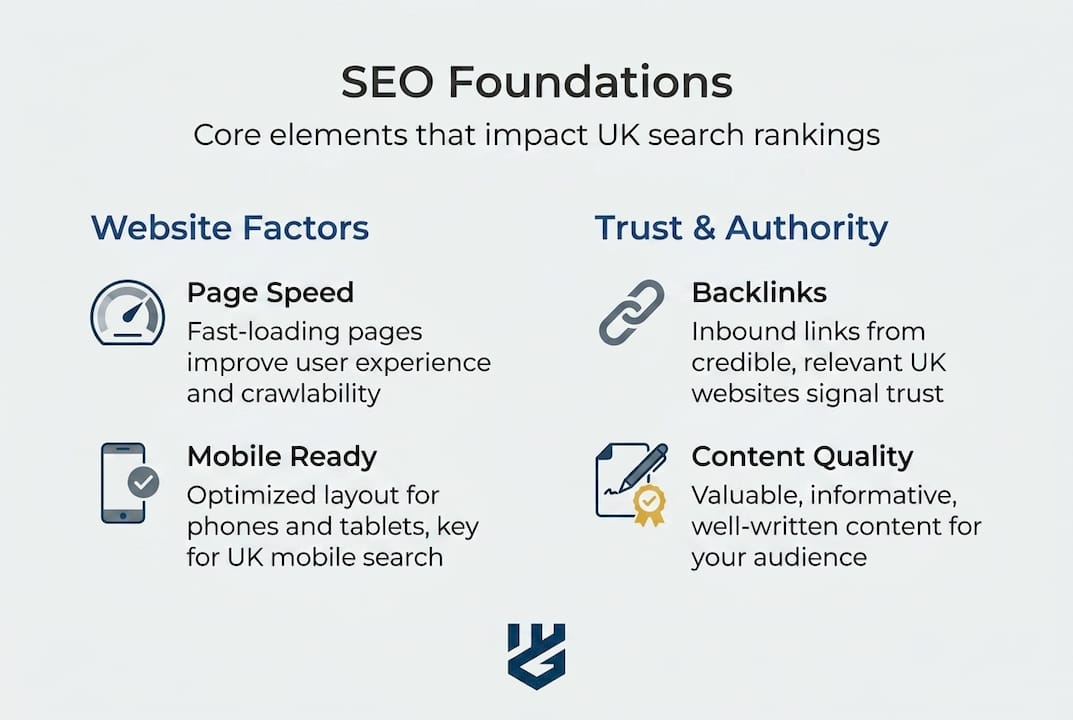
Technical SEO covers everything that makes your site easy for search engines to find, read, and trust. Think of it as the plumbing behind the walls: invisible to visitors, but absolutely critical. Core web vitals, HTTPS, and mobile design are now fundamental ranking requirements, not optional extras. A site that loads slowly, serves broken links, or fails on a smartphone will struggle regardless of how good the content is.
Content quality is about relevance and depth. Google’s systems are sophisticated enough to distinguish between a page that genuinely answers a question and one that just repeats keywords. For UK SMEs, this means writing for real people with real local intent, not just stuffing location names into generic paragraphs.
Authority relates to how trustworthy and credible your site appears to Google. Backlinks (links from other websites pointing to yours) are the main currency here, but local citations and your Google Business Profile also contribute significantly.
Here is a simple comparison of the three pillars:
| Pillar | What it covers | Impact on rankings |
|---|---|---|
| Technical SEO | Speed, security, structure, mobile | Foundation: without this, nothing else works |
| Content quality | Keywords, relevance, depth, local intent | Determines which searches you appear for |
| Authority | Backlinks, citations, reviews, GBP | Determines how high you rank vs competitors |
For UK SMEs specifically, the stakes are high. Millions of searches with strong buying intent happen daily across towns and cities throughout England, Scotland, Wales, and Northern Ireland. Appearing on page one for even two or three of those searches can translate into dozens of new enquiries each month. Understanding search ranking strategies from the outset helps you prioritise the right work and avoid wasting budget on tactics that sound impressive but deliver little.
Key things Google prioritises for modern websites:
- Page speed: both desktop and mobile load times matter enormously
- Usability: can real users navigate your site easily?
- Security: HTTPS is now a baseline expectation, not a bonus
- Structured data: schema markup helps Google understand your pages at a glance
- Consistent signals: NAP (name, address, phone) consistency across the web
“Google processes billions of searches each day, and its algorithms now reward genuine expertise, relevance, and user experience above all else. Websites that satisfy these criteria consistently outperform those built solely around keyword manipulation.”
Lay the groundwork: technical SEO essentials for UK businesses
Technical SEO is the non-negotiable starting point. No amount of brilliant content will carry you to page one if Google struggles to crawl, index, or trust your site. The good news is that most technical issues are fixable, and fixing them often produces visible ranking improvements within weeks.
Core web vitals, mobile-responsiveness, and error-free indexing are the three areas where UK SMEs most commonly fall short. Here is what each one means in practice:
| Core web vital | What it measures | Target threshold |
|---|---|---|
| LCP (Largest Contentful Paint) | How fast the main content loads | Under 2.5 seconds |
| INP (Interaction to Next Paint) | How quickly pages respond to clicks | Under 200 milliseconds |
| CLS (Cumulative Layout Shift) | How much the page jumps around during loading | Score below 0.1 |
These metrics are measured by Google and directly influence your position in search results. A local plumbing company in Manchester with a fast, stable site will consistently outrank a competitor with a slow, unstable one, even if the competitor has been trading for decades longer.
Follow these steps to address your technical baseline:
- Switch to HTTPS if you have not already. Any site still running on HTTP is sending a trust warning to both visitors and Google. Your hosting provider can usually enable an SSL certificate at low or no cost.
- Test your mobile experience using Google’s free tools. Open your site on an actual smartphone. If text is tiny, buttons overlap, or you need to pinch and zoom, your mobile experience needs work.
- Check page speed with Google PageSpeed Insights. Aim for a score above 70 on mobile. Common culprits for slow speeds include uncompressed images, excessive plugins, and unminified code.
- Submit an XML sitemap to Google Search Console. This tells Google exactly which pages exist and should be indexed. Most website platforms generate sitemaps automatically.
- Review your robots.txt file to ensure you are not accidentally blocking important pages from being crawled.
- Fix crawl errors and 404 pages. Google Search Console flags these clearly. Broken links erode trust and waste your crawl budget.
- Eliminate duplicate content. If the same content appears at multiple URLs, use canonical tags to tell Google which version is the definitive one.
These website optimisation steps are the same ones we apply at the very start of every client engagement, because skipping them makes everything else harder. Many UK SMEs are surprised to discover how many technical errors their site contains before a proper audit.
Pro Tip: Use Google Search Console’s “Coverage” report monthly. It shows you exactly which pages are indexed, which are excluded, and why. Fixing exclusions systematically can unlock significant ranking improvements with no new content required.
It is also worth addressing common local SEO pitfalls at this stage, particularly inconsistent business name and address formatting, which confuses both Google and directory databases.
Create content that converts: on-page SEO for local SMEs
Once your technical foundations are solid, content becomes your most powerful lever. On-page SEO refers to everything on the page itself: the words, the structure, the headings, and the metadata. Get this right and you can compete directly against much larger businesses for valuable local search terms.

Start with keyword research that reflects actual buying intent. There is a significant difference between someone searching “plumber” and someone searching “emergency boiler repair Leeds tonight.” The second search signals urgency and intent to hire. For UK SMEs, targeting these high-intent, locally specific phrases consistently delivers more enquiries per visitor. Focused content delivers 3.4x visibility and can drive up to 30% higher search volume for UK SMEs compared to generic, unfocused pages.
Here is how to structure any service page for maximum SEO impact:
- Page title (H1): include your primary keyword and location naturally, for example “Boiler repair and installation in Leeds”
- Meta description: write 150 to 160 characters that describe the page benefit and include a call to action; this appears in search results and directly affects click-through rates
- Header tags (H2, H3): break the page into logical sections; each H2 should target a related keyword phrase
- Body content: aim for at least 500 words on service pages; answer the questions your customers actually ask
- Internal links: connect related pages to help both users and Google navigate your site
Schema markup is worth particular attention. This is structured data code (usually in JSON-LD format) that you add to your pages to help Google understand exactly what your business offers. The most valuable types for UK SMEs are:
- LocalBusiness schema: includes your name, address, phone, opening hours, and service area
- FAQ schema: marks up question and answer content so it can appear as an expandable feature in search results
- Review schema: can display star ratings directly in search results, dramatically improving click-through rates
- Service schema: describes specific services you offer, which helps you appear for detailed, service-specific searches
You can explore the advantages of website optimisation to understand how these on-page improvements compound over time. Looking at local business SEO case studies also reveals patterns in what genuinely moves the needle for UK businesses across different sectors.
Pro Tip: Rewrite your top three service pages first. Prioritise the ones that represent your highest revenue services. A well-optimised page for your most profitable offering can pay back the effort many times over within a single quarter.
Build trust and authority: off-page SEO actions for UK SMEs
Off-page SEO refers to everything that happens away from your own website but still affects where you rank. It is largely about signals of trust and authority: other credible sources vouching for your business, either through links, citations, or reviews.
UK SMBs moving from weak to strong off-page signals have reported up to 400% increases in local search enquiries. That is a transformative change that no paid ad campaign can sustain cost-effectively over the long term.
Backlinks remain the most powerful off-page ranking signal. Not all backlinks are equal. Here is a comparison of common link-building approaches:
| Approach | Quality level | Example |
|---|---|---|
| Local news coverage or press | Very high | Being featured in a regional newspaper online |
| Industry association listings | High | A directory from your trade body or professional association |
| Supplier or partner links | Medium to high | A link from a supplier’s “trusted partners” page |
| Generic web directories | Low | Low-quality, mass-submission directory sites |
| Guest articles on relevant blogs | High if niche-relevant | Writing for a local business blog in your sector |
For most UK SMEs, the fastest off-page wins come from:
- Google Business Profile (GBP): complete every field, add photos weekly, post updates regularly, and respond to every review. GBP is the single most influential factor in appearing in map pack results.
- Local citations: ensure your business name, address, and phone number appear consistently across Yell, Bing Places, Apple Maps, and relevant trade directories.
- Customer reviews: actively request reviews from satisfied clients. A steady flow of genuine five-star reviews on Google builds authority rapidly.
- Local partnerships: collaborate with complementary businesses in your area and look for natural opportunities to earn links from their websites.
Understanding local SEO ranking tips in depth reveals just how much opportunity exists in the off-page space for businesses that have not yet focused there. Many SMEs also overlook why they are not showing up for near me searches, which often traces back to inconsistent citations or an underdeveloped Google Business Profile.
Social proof is an increasingly important trust signal too. A business with 200 positive Google reviews and an active GBP listing simply looks more credible than one with three reviews and a blank profile, both to potential customers and to Google’s local ranking algorithms.
Our perspective: why chasing quick SEO wins often leads to long-term setbacks
After more than 20 years working in SEO, the pattern we see most often with UK SMEs is this: a business invests a few weeks in SEO, sees no instant results, then either abandons the strategy entirely or pivots to buying cheap links or using AI-generated content at scale. Both of those moves tend to make things worse, not better.
Real ranking gains take time because they are built on trust, and trust is earned incrementally. We have worked with clients who saw modest progress in months one and two but dramatic growth by month six, simply because they stayed consistent with technical fixes, content improvements, and citation building. Those results compound. A link earned today is still working for you in two years.
The most successful UK SMEs we work with treat SEO the same way they treat their reputation: as something worth protecting and nurturing over time, not a tap to switch on and off. Reading through our SEO case studies makes this pattern very clear. Businesses that commit, adapt based on data, and avoid shortcuts consistently outperform those chasing the algorithm.
Take your search rankings further with expert support
Applying everything in this guide takes time and specialist knowledge that most business owners understandably do not have spare. That is where professional SEO support changes the equation.
At Gregg King, we have spent over 20 years helping UK SMEs move from invisible to in demand through structured, measurable SEO. Whether you need a full review of your SEO and website design, focused support with your Google Business Profile, or a broader strategic plan, we tailor every approach to your specific business goals and sector. Our digital marketing guide for UK small businesses is also a useful starting point if you want to map out your options before committing. Get in touch for a free consultation and see exactly where your biggest opportunities lie.
Frequently asked questions
How long does it take to see improved search rankings using SEO?
UK SMEs typically see measurable gains within three to six months, with significant traffic and conversion growth by month nine, provided foundational work is done consistently from the start.
What is the most important factor in improving search rankings?
Technical SEO forms the critical foundation, but sustainable ranking requires strong content and authority signals working together; no single element alone delivers lasting results.
How can I track if my UK business’s search rankings are improving?
Google Search Console is the best free starting point: it shows your average position, clicks, impressions, and keyword data directly from Google, alongside any indexing or crawl errors affecting your visibility.
Why is my business not showing up for ‘near me’ searches?
Strong local signals and a complete GBP profile are essential for map pack and near me appearances; inconsistent citations or an incomplete profile are the most common reasons businesses miss these high-intent searches entirely.
Are paid ads a substitute for improving organic search rankings?
No. Paid ads can deliver short-term traffic while organic rankings build, but they stop the moment your budget does, whereas strong organic rankings continue driving enquiries indefinitely at no cost per click.