
TL;DR:
- Google now ranks websites based on visitor engagement and behavior signals.
- UX factors like mobile responsiveness, loading speed, and navigation are crucial for SEO.
- Small improvements in UX can outperform traditional SEO tactics like content and backlinks.
Most business owners assume that SEO is about stuffing the right keywords onto a page or collecting as many backlinks as possible. That thinking is now outdated. Google has quietly shifted how it evaluates websites, placing enormous weight on how real visitors actually behave once they arrive. If people land on your site and leave immediately, Google notices. If they stay, click around, and engage, Google rewards that too. Positive behavioural signals from a well-designed experience now do more for your rankings than most traditional tactics. This guide explains exactly how UX (user experience) drives SEO success, and what UK SMEs can do about it today.
Table of Contents
- Why UX now drives SEO success
- Core UX factors that impact search rankings
- The balancing act: SEO structure vs user-first design
- Practical steps to improve UX for better rankings
- Why most SMEs underestimate UX in SEO (and what actually works)
- Take your UX and SEO to the next level
- Frequently asked questions
Key Takeaways
| Point | Details |
|---|---|
| User behaviour signals matter | Sites that keep visitors engaged and reduce bounce rate now outrank those relying on keywords alone. |
| Mobile and speed come first | Fast-loading, mobile-optimised sites see immediate improvements in both search position and customer retention. |
| Balance SEO and UX | Over-optimisation for search engines at the cost of usability will hurt both engagement and rankings. |
| Small tweaks, big results | Simple changes like streamlining menus and boosting Core Web Vitals offer fast SEO gains for UK SMEs. |
Why UX now drives SEO success
Google has always wanted to surface the most useful, trustworthy results. The challenge was measuring “useful” at scale. For years, keywords and backlinks were the closest proxy available. But as Google’s algorithms matured, the search engine began reading something far more telling: how people actually use a website.
UX, or user experience, covers everything from how fast your pages load to how easy it is to find information. It shapes whether a visitor feels confident or confused, satisfied or frustrated. And those feelings translate directly into measurable behaviours that Google tracks.
| Behavioural signal | What it measures | SEO impact |
|---|---|---|
| Bounce rate | Visitors who leave after one page | High bounce = low relevance signal |
| Dwell time | How long visitors stay | Longer stay = higher perceived value |
| Pages per session | How many pages are visited | More pages = stronger engagement |
| Click-through rate | Clicks from search results | Higher CTR signals relevance |
These behavioural metrics now act as tie-breakers in competitive search results. Two websites with similar keywords and backlinks will be separated by which one users clearly prefer. That is a significant shift in how the game is played.
“Experience is now what search engines use to predict satisfaction. If your site frustrates visitors, Google assumes it frustrates everyone.”
For UK small businesses, the website optimisation advantages of getting this right are substantial. You do not need to outspend larger competitors on link-building campaigns. You need to out-experience them. Practical improvements to your site’s layout, speed, and navigation can move you up the rankings faster than months of content production.
Understanding that web design drives SEO is not just a technical detail. It reframes your entire approach to digital marketing. Every design decision becomes an SEO decision.
Here is what Google uses to form its picture of your site:
- Time spent on page after clicking from search results
- Whether the visitor returns to Google immediately (a “pogo-stick” signal)
- Overall session depth across multiple pages
- Mobile usability and load performance scores
Core UX factors that impact search rankings
Knowing UX matters, what specific aspects should UK SMEs focus on for SEO advantage? There are several high-impact areas worth prioritising. The good news is that most of them do not require a complete website rebuild.
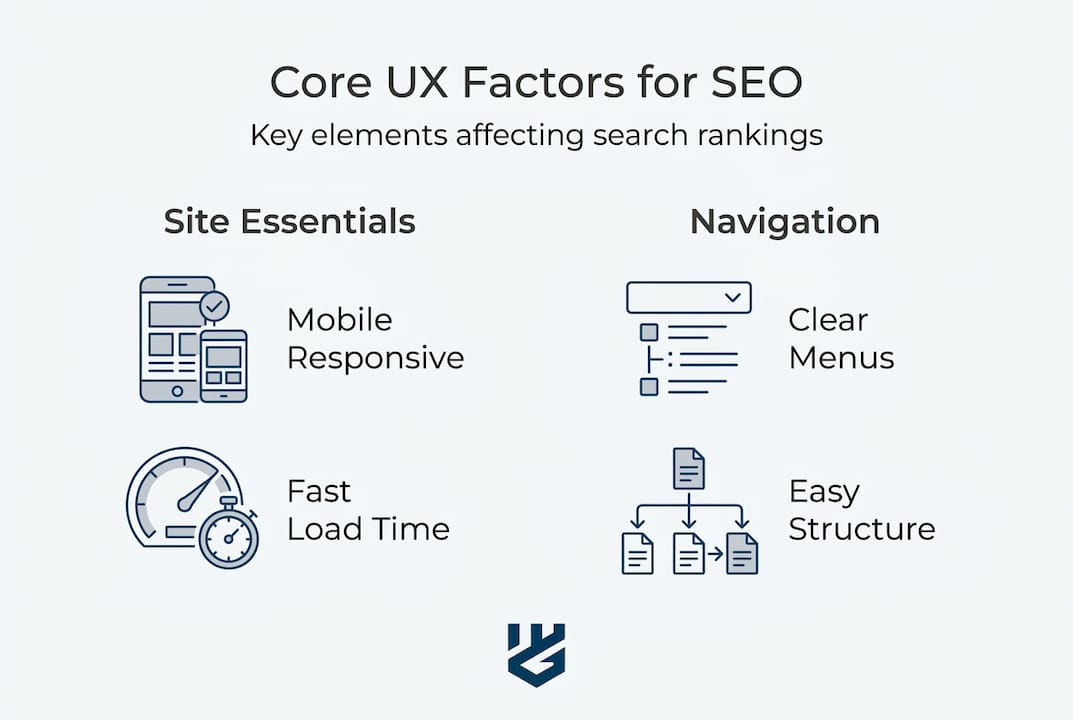
Mobile responsiveness sits at the top of the list. The majority of searches now happen on smartphones, and Google uses mobile-first indexing, meaning it evaluates your mobile site, not your desktop version, when deciding where to rank you. A site that looks fine on a laptop but breaks on a phone is actively hurting your visibility.
Navigation structure matters more than most business owners realise. If a visitor cannot find what they are looking for within a few clicks, they leave. Simple, clearly labelled menus reduce friction and increase the pages-per-session metric that Google values.
Loading speed is perhaps the most measurable UX factor. UX enhancements like faster load times directly improve both user engagement and search rankings. A delay of even one second can increase bounce rates noticeably.

Here is how common UX issues compare in their SEO impact:
| UX issue | Effect on user | Effect on SEO |
|---|---|---|
| Slow load time | Immediate frustration | Higher bounce rate, lower ranking |
| Poor mobile layout | Difficult to read or navigate | Penalised by mobile-first indexing |
| Cluttered navigation | Confusion and exit | Fewer pages visited, lower dwell time |
| No clear CTAs | Users unsure what to do next | Lower conversion and engagement |
Follow these steps to tackle the most critical UX factors first:
- Test your site on a smartphone and note every point of friction
- Check your current load speed using free tools like Google PageSpeed Insights
- Review your main navigation and remove or rename anything ambiguous
- Ensure every key page has one obvious next step for the visitor
- Review your website design tips to align design choices with SEO goals
Pro Tip: Your calls to action (CTAs) should guide users naturally toward the next logical step. A confused visitor is a lost visitor. One clear, benefit-led CTA per page outperforms five competing buttons every time.
Building this foundation connects directly with how SEO and website design work together as a unified strategy rather than separate disciplines.
The balancing act: SEO structure vs user-first design
Let’s dig into the common pitfalls UK businesses face when trying to optimise both UX and SEO. The tension is real, and getting the balance wrong is surprisingly easy.
SEO best practice often encourages a deep internal linking structure, with many pages connected to signal topical authority. But taken too far, this creates websites with dozens of navigation options, redundant category pages, and menus that overwhelm rather than guide. Real users do not want to explore a labyrinth. They want answers quickly.
Intrusive pop-ups are another common conflict. Many businesses use pop-ups for email sign-ups or promotions, which can serve a purpose. But poorly timed or impossible-to-close pop-ups directly harm engagement signals, causing visitors to bounce before they even read a single line of content. Google has explicitly penalised mobile sites with disruptive interstitials.
Long-form content is frequently recommended for SEO because length can signal depth and authority. But length alone is not the answer. Content that rambles, repeats itself, or buries key information under walls of text creates what is known as content bloat. Visitors skim, fail to find what they need, and leave. That behaviour tells Google the page is not satisfying the search intent.
Here are the most common UX-SEO conflicts to watch for:
- Deep site structures that confuse navigation while appearing thorough to search engines
- Keyword-stuffed headings that sound unnatural and disrupt reading flow
- Pop-ups or banners timed to appear the moment a visitor lands
- Excessive internal links crammed into body text, reducing readability
- Long pages with no logical structure or visual hierarchy
Applying proven SEO strategies means knowing when to pull back, not just push forward.
Pro Tip: Try progressive disclosure. Start with the essential information a visitor needs. Let natural curiosity and clear navigation pull them deeper into your content. This approach mirrors how people actually read online and keeps engagement high throughout the session.
Working with an experienced SEO consultant helps you identify exactly where that balance sits for your specific market and audience.
Practical steps to improve UX for better rankings
With these conflicts in mind, here is how your business can practically upgrade UX for measurable SEO gains. The process does not need to be overwhelming. Start with the highest-impact changes and build from there.
- Run a Core Web Vitals audit. Use Google PageSpeed Insights to check your scores for Largest Contentful Paint, Interaction to Next Paint, and Cumulative Layout Shift. These three scores directly influence rankings. Fix the biggest issues first.
- Simplify your navigation. Limit top-level menu items to five or six. Use plain language that matches what your customers actually search for. Avoid clever or creative labels that obscure meaning.
- Compress and optimise images. Oversized image files are one of the most common causes of slow load times. Tools like Squoosh or ShortPixel reduce file size without visible quality loss.
- Enable lazy loading. This ensures images and videos only load when a visitor scrolls to them, rather than all at once. It dramatically improves initial page speed.
- Set up analytics monitoring. Use Google Analytics or a similar tool to track dwell time and bounce rate by page. This reveals which pages are working and which are driving visitors away.
- Collect real user feedback. Tools like Hotjar show heatmaps of where visitors click and scroll. This uncovers friction points that no SEO tool will reveal.
For competitive search results, Core Web Vitals act as tie-breakers, which means a business with a slight keyword disadvantage can outrank a competitor simply by delivering a faster, smoother experience.
Revisiting your web design for SEO success through this lens transforms how you think about every page on your site. Pair that with solid design tips for UK business and you have a repeatable process for continued improvement.
Why most SMEs underestimate UX in SEO (and what actually works)
After years of working with UK businesses, a clear pattern emerges: most SMEs know they need better SEO, but they focus almost entirely on keywords and content, while leaving obvious UX problems completely unaddressed.
The reason is partly how SEO tools are designed. They surface keyword gaps, missing meta descriptions, and backlink counts. They rarely highlight that your menu is confusing, your font is too small on mobile, or your contact page takes four seconds to load. Yet those issues are doing far more damage to your rankings than a missing keyword.
Expert research confirms that Google predicts user satisfaction through behavioural signals and Core Web Vitals, not through a dedicated “UX score.” That means UX is an indirect but dominant ranking factor, and it is one that most businesses are simply not measuring.
In practice, small adjustments in layout, menu logic, and load speed routinely outperform months of new content or fresh link-building. A business that fixes its mobile navigation this week will likely see ranking improvements before a business that publishes ten new blog posts.
Pro Tip: Track what your best-converting visitors do on your site, not just what SEO tools recommend. If paying customers consistently navigate from your homepage to a specific service page, that path deserves to be made faster and clearer for everyone. Real UX and SEO improvement starts with understanding actual human behaviour, not just algorithmic checklists.
Take your UX and SEO to the next level
Understanding the connection between UX and SEO is one thing. Implementing it consistently, across every page, on every device, is where most businesses need support. A poorly optimised site costs you visibility every single day.
At Gregg King, we specialise in SEO and website design that works together as a single, coherent strategy for UK SMEs. From technical audits to full site redesigns, every decision is made with both the user and the search engine in mind. If you are ready to stop guessing and start seeing measurable results, find out how the SEO consultant advantages of working with an experienced specialist can transform your online presence. Get in touch today for a free consultation.
Frequently asked questions
How exactly does user experience influence Google rankings?
Google tracks how visitors interact with your site, including time spent and pages visited, using these behavioural signals to judge whether your site genuinely satisfies searchers, which directly shapes where you rank.
What are the quickest UX fixes for SEO?
Improving site speed, simplifying navigation, and ensuring your site works properly on mobile are the fastest routes to better rankings, as these enhancements consistently improve engagement and search performance simultaneously.
Can focusing too much on SEO harm user experience?
Absolutely. Overly complex site structures, keyword-heavy content, and intrusive pop-ups all frustrate real visitors and send negative signals back to Google, which can actively reduce your rankings.
Which UX metric should UK SMEs prioritise?
Core Web Vitals are the most important starting point, as these scores directly influence both your search rankings and the quality of experience your visitors receive on every page.