
TL;DR:
- UK small businesses need structured website optimization focusing on speed, content, and technical performance.
- Target local, long-tail keywords and improve Core Web Vitals for better visibility and user engagement.
- Combining SEO and CRO through ongoing testing yields better results than pursuing either separately.
Most UK small businesses have a website, but far fewer have one that actually works hard enough to win customers. If your site attracts visitors who quietly leave without making contact, you are not alone. Weak visibility, slow loading times, and generic content are costing UK SMEs real revenue every single day. The good news is that a structured, step-by-step optimisation process can turn this around without a complete rebuild or a huge budget. This guide walks you through exactly what to do, in the right order, so you can start seeing measurable improvements in traffic and customer engagement.
Table of Contents
- Essential tools and planning for website optimisation
- Step 1: Find the right UK keywords for your audience
- Step 2: Enhance technical performance and speed
- Step 3: Build compelling content and structure links
- Step 4: Convert visitors with evidence-led testing
- A smarter approach to website optimisation for UK SMEs
- Partner with experts for lasting optimisation results
- Frequently asked questions
Key Takeaways
| Point | Details |
|---|---|
| Use local UK keywords | Researching and deploying UK-specific keywords attracts relevant local customers. |
| Optimise speed and mobile | Improving load time and mobile experience reduces visitor drop-off and boosts conversion rates. |
| Create and update quality content | Publishing helpful, UK-focused service pages and blogs grows authority and search visibility. |
| Test and refine with CRO | A/B testing headlines and calls to action can increase revenue by up to 63% for SMEs. |
Essential tools and planning for website optimisation
Before you change a single word or image on your site, you need an honest picture of where things stand. Jumping straight into fixes without a baseline is like decorating a room before checking for damp. You might feel productive, but you are solving the wrong problems.
Start with these essential tools:
- Google Search Console (free): shows which pages rank, which queries trigger your site, and where you are losing clicks
- Google PageSpeed Insights (free): scores your site on speed and Core Web Vitals
- Google Analytics 4 (free): tracks user behaviour, bounce rates, and conversion paths
- Ahrefs or SEMrush (paid): provides deep keyword data, backlink analysis, and competitor insights
- Screaming Frog (freemium): crawls your site for broken links, missing meta tags, and duplicate content
Once your tools are ready, audit what you have. Look at load speed, mobile usability, page structure, and keyword visibility. Categorise findings into two groups: quick wins (fixable within days) and longer-term work (requiring content creation or development support).
| Priority tier | Example tasks | Typical effort |
|---|---|---|
| Quick wins | Fix broken links, add meta descriptions | 1 to 3 days |
| Medium-term | Optimise images, improve page structure | 1 to 2 weeks |
| Longer-term | Create new service pages, build backlinks | 1 to 3 months |
For website design improvement tips, combining a solid audit with clear priorities is the single biggest time saver in any optimisation project.
Pro Tip: Run Google PageSpeed Insights on your three most-visited pages first. You will almost certainly find image or render-blocking issues that can be resolved quickly and deliver an immediate score improvement.
As part of your preparation, SEO checklist tools recommend conducting keyword research using Google autocomplete, Search Console, and tools like Ahrefs or SEMrush to identify the local UK terms your customers are actually searching.
Step 1: Find the right UK keywords for your audience
Keyword research is not about finding the most-searched term. It is about finding the right term for your specific audience in your specific location. A plumber in Leeds needs entirely different target phrases than a plumber in Brighton.
Here is a clear process to follow:
- Open Google and type your main service followed by your location. Note every autocomplete suggestion.
- Check Search Console to see which queries are already driving impressions to your site.
- Use SEMrush or Ahrefs to find long-tail variations with commercial intent, such as “affordable accountant Manchester” or “emergency boiler repair Birmingham.”
- Filter out informational phrases (“what is VAT”) in favour of transactional ones (“VAT returns service London”).
- Build a simple spreadsheet with keyword, monthly search volume, competition level, and the page you will target.
A keyword research guide recommends targeting long-tail phrases with commercial intent, focusing on local UK terms through Google autocomplete, Search Console, Ahrefs, and SEMrush for the most reliable local data.
| Tool | Cost | Best for | Local UK data |
|---|---|---|---|
| Google Search Console | Free | Current rankings and impressions | Strong |
| Google Autocomplete | Free | Discovering real search phrases | Strong |
| SEMrush | Paid | Competitor gap analysis | Very strong |
| Ahrefs | Paid | Backlink and keyword depth | Very strong |
For local search ranking strategies, the most overlooked opportunity is targeting phrases your competitors rank for but where you have strong local relevance. Also, explore SEO keyword growth tips to keep your keyword strategy evolving as your business grows.
Pro Tip: Avoid targeting broad single-word terms like “solicitor” or “dentist.” These are dominated by national directories. Instead, focus on two to four word phrases with a location, which convert far better and are actually winnable for an SME.
Step 2: Enhance technical performance and speed
Once you are targeting the right keywords, technical and speed improvements ensure those visitors do not leave before they have read a single word. Speed is not a nice-to-have. It is a ranking signal and a conversion driver.
UK-specific benchmarks to aim for:
- PageSpeed score: 80 or above on mobile
- Largest Contentful Paint (LCP): under 2.5 seconds
- First Input Delay (FID): under 100 milliseconds
- Cumulative Layout Shift (CLS): below 0.1
Practical fixes to action now:
- Compress all images using a tool like ShortPixel or Smush
- Enable browser caching through your hosting settings or a plugin
- Minify CSS and JavaScript files to reduce file size
- Use a Content Delivery Network (CDN) to serve files faster across the UK
- Remove unused plugins or scripts that slow page rendering
Research on site speed research is clear: compress images, enable caching, use a CDN, and minify CSS and JS, aiming for a PageSpeed score above 80 on mobile.

| CMS platform | Core Web Vitals pass rate |
|---|---|
| WordPress | 43 to 44% |
| Shopify | 75% |
Only around 50% of sites pass all Core Web Vitals benchmarks, and poor LCP performance drops conversions by 7% for every additional second of delay. That is a significant revenue leak for any SME.
For practical design tweaks for faster sites, even small changes like lazy-loading images or switching to a faster hosting tier can push your scores above the threshold Google rewards.
Step 3: Build compelling content and structure links
With technical performance addressed, focus on the information, messaging, and navigation that drives customers to take action. Great content is what keeps someone on your site long enough to trust you.
Here is how to approach your key pages:
- Homepage: Lead with your value proposition in the first heading. Use clear, benefit-driven language and a prominent call to action above the fold.
- Service pages: Each service should have its own dedicated page. Write at least 300 words per page, include your target keyword naturally at a 2 to 4% density, and answer the questions your customers are actually asking.
- Blog posts: Aim for 1,000 words or more. Cover topics that answer specific local questions, such as “how to find a reliable builder in Sheffield.”
- Internal links: Every page should link to at least two or three related pages. This helps users navigate and signals structure to search engines.
A comprehensive content SEO checklist confirms that high-quality content with 300-plus words on service pages and 1,000-plus words on blogs, combined with natural keyword density of 2 to 4% and a solid internal linking structure, produces measurable SEO gains.
Bullet points to keep in mind for content quality:
- Write for your customer first, not for search engines
- Use subheadings to break up text and aid scanning
- Include real examples, locations, or case studies relevant to your sector
- Add a clear call to action at the end of every page
For a broader view of the benefits of website optimisation, consistently updated and well-structured content is one of the strongest long-term signals Google rewards.
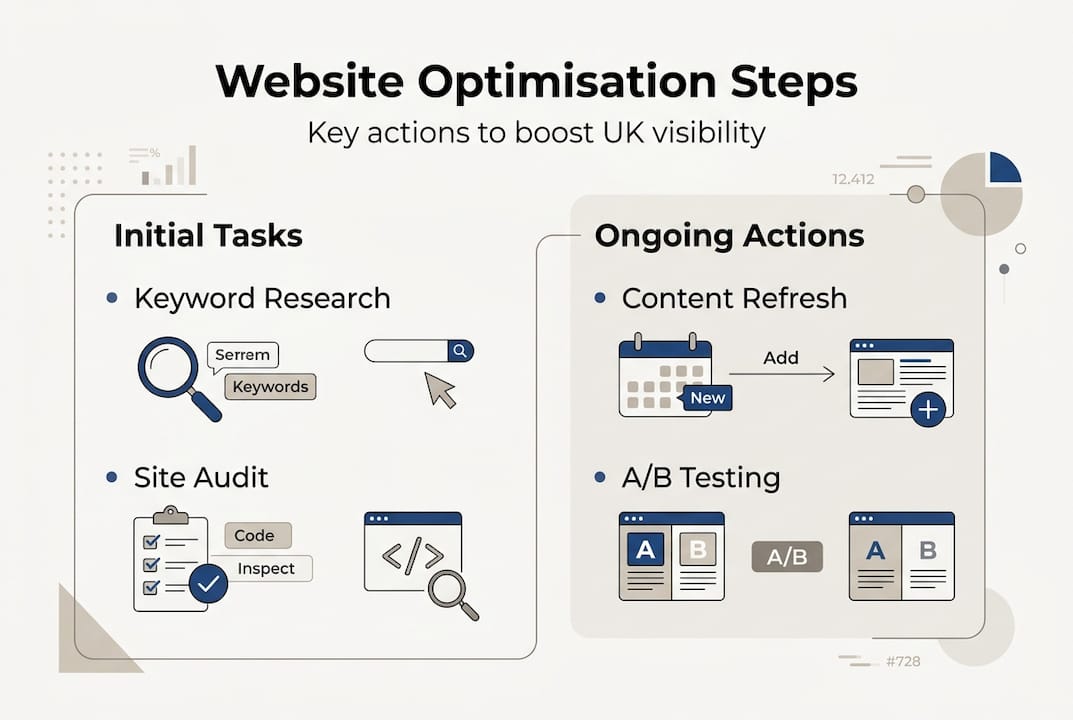
Pro Tip: Refresh your top five pages every three to six months. Update statistics, add new sections, and adjust keywords. Google treats recency as a quality signal, and a small update can revive a page that has slipped in rankings.
Step 4: Convert visitors with evidence-led testing
Optimisation does not stop once your content is live. The next step is converting more of your existing visitors into paying customers using structured testing, known as conversion rate optimisation (CRO).
CRO is simply the practice of running controlled experiments on your site to find what persuades more visitors to take action, whether that is filling in a form, calling you, or making a purchase.
How to run your first A/B test:
- Pick a single page with meaningful traffic, ideally a service page or landing page.
- Form a hypothesis: “Changing the headline to focus on a specific benefit will increase enquiries.”
- Create version B with only one change (headline, button colour, or CTA wording).
- Use a tool like Google Optimize or VWO to split traffic 50/50.
- Run the test for two to four weeks to gather statistically significant results.
- Apply the winning version and document your finding for future tests.
“Evidence beats gut feel every single time. The businesses that test systematically outperform those that rely on assumptions, and the data backs this up.”
Systematic A/B programmes show that 63% of businesses that run hypothesis-driven A/B tests see a measurable increase in revenue. Calculate your required sample size before you start to avoid drawing conclusions too early, a common and costly mistake for SMEs.
Start small. Test a single headline or button. The insight you gain from one well-run test is worth more than a dozen website redesigns based on instinct.
A smarter approach to website optimisation for UK SMEs
Here is something most digital marketing guides will not tell you: treating SEO and CRO as two separate projects is one of the most common and expensive mistakes UK SMEs make. You will find plenty of agencies that handle search rankings in one team and conversion testing in another, but your website does not work that way. Traffic and conversion are one continuous system.
We have seen businesses invest months in ranking improvements, only to send newly-won visitors to a page with a confusing layout or a weak call to action. The traffic arrives and leaves immediately. All that effort produces nothing.
The smarter approach is running small, evidence-based A/B tests alongside every content update. When you refresh a service page for SEO, also test a new headline or form layout at the same time. This way, your website design best practices compound with your SEO work rather than operating in isolation.
A key insight from growth experiments research is the distinction between optimisation (making what exists better) and growth experiments (testing entirely new approaches). For most SMEs, optimisation is the right starting point. Keep it simple, keep it evidence-based, and resist the temptation to overhaul everything at once.
Partner with experts for lasting optimisation results
If working through keyword research, technical audits, content planning, and A/B testing simultaneously feels like a lot to manage alongside running your business, that is completely understandable.
At Gregg King, we bring over 20 years of UK digital marketing experience to businesses exactly like yours. Our SEO and website design services are built around the same step-by-step framework covered in this guide, tailored to your sector and your goals. We also offer Google Business Profile services to strengthen your local presence alongside your website. Whether you need a full strategy or help with one specific area, explore our quick website upgrade tips or get in touch for a free consultation.
Frequently asked questions
How much time do I need to optimise my website step by step?
Most small UK businesses can complete full optimisation in 4 to 8 weeks, allocating a few focused hours each week. A/B tests alone require 2 to 4 weeks to gather reliable data before drawing conclusions.
Which website areas should I start with for a quick visibility boost?
Begin with local UK keyword targeting and page speed improvements, as both deliver fast results. Focusing on local UK terms and achieving a PageSpeed score above 80 on mobile are the two highest-impact starting points.
What is the minimum content length for service pages and blogs?
Aim for at least 300 words on service pages and 1,000 words on blog posts. Research confirms that 300-plus word service pages with natural keyword use consistently outperform thinner pages in UK search results.
How can I tell if my website passes core web vitals?
Use Google PageSpeed Insights or Search Console to check your scores. Only around 50% of sites currently pass all Core Web Vitals benchmarks, so passing puts you ahead of many competitors straightaway.