TL;DR:
- Optimizing title tags with relevant keywords and proper length improves search rankings and click-through rates.
- Clear content structure with appropriate headers and natural keyword use enhances SEO and user experience.
- Ensuring technical elements like mobile-friendliness, site speed, and HTTPS are crucial for effective on-page SEO.
Getting found on Google when you have hundreds of local competitors is genuinely hard. For UK small and medium-sized businesses, the gap between page one and page two is often the difference between a steady flow of enquiries and digital silence. On-page SEO, which refers to all the optimisation work done directly on your website’s pages, is one of the most reliable ways to close that gap. The good news is that title tags are the most important on-page element, and getting them right alongside a handful of other techniques can deliver meaningful ranking improvements without a huge budget.
Table of Contents
- Mastering title tags and meta descriptions
- Optimising headers, content structure, and keyword use
- Internal links, images, and user engagement signals
- Mobile-friendliness, speed, and technical on-page essentials
- Our perspective: What most guides miss about on-page SEO
- Ready to implement powerful on-page SEO in your business?
- Frequently asked questions
Key Takeaways
| Point | Details |
|---|---|
| Focus on title tags | Craft compelling, keyword-rich title tags for maximum search impact. |
| Structure content smartly | Organise headers and keyword use so users and Google understand your site easily. |
| Link and engage | Use internal links, optimised images, and clear CTAs to boost engagement and SEO scores. |
| Stay fast and mobile-ready | Technical essentials like speed and mobile-friendliness directly shape your search rankings. |
Mastering title tags and meta descriptions
Every page on your website has a title tag. It is the blue clickable headline you see in Google’s search results, and it is your first and best opportunity to tell both Google and your potential customers what that page is about. On-page SEO best practices consistently place title tags at the top of the priority list because they influence both your ranking position and the number of people who actually click through to your site.
The sweet spot for title tags is 50 to 60 characters. Go shorter and you leave valuable space unused. Go longer and Google will truncate the tag, cutting off your message mid-sentence. Most importantly, lead with your primary keyword. If you run a plumbing business in Manchester, a title like “Emergency plumber in Manchester | Fast Response” is far stronger than “Welcome to our plumbing website.” The keyword at the front signals relevance immediately.
Here is a quick comparison to illustrate the difference:
| Element | Weak example | Strong example |
|---|---|---|
| Title tag | Welcome to Smith & Sons | Accountants in Leeds |
| Meta description | We offer lots of services for businesses | Award-winning accountants in Leeds helping SMEs save tax. Book free today. |
Meta descriptions do not directly affect rankings, but they absolutely affect clicks. Think of your meta description as a 155-character advert for your page. Include a benefit, a keyword, and a clear prompt to act. A page with a compelling description consistently attracts more visitors than one with a dull or auto-generated snippet.
Pro Tip: Write your title tag first, then craft your meta description to complement it. The two should work as a team, not repeat the same words.
Google rewrites title tags it considers poorly written, which means your carefully chosen phrasing may never reach the searcher. Getting them right the first time keeps you in control of your first impression.
Common mistakes to avoid:
- Using the same title tag on multiple pages
- Stuffing too many keywords into one tag
- Writing meta descriptions that are vague or generic
- Forgetting to include a location keyword for local businesses
- Letting your CMS auto-generate titles from page filenames
For more context on how title tags fit into a broader strategy, the tips to rank high on Google guide covers how these on-page elements connect to the wider picture of search visibility. The relationship between SEO and website design also plays a role here, since a well-structured site makes it easier to assign unique, purposeful titles to every page.
Optimising headers, content structure, and keyword use
With your meta information sorted, the next step is making sure your page’s written content is structured clearly for both readers and search engines. Headers (the H1, H2, and H3 tags in your site’s code) act like a table of contents. They tell Google what each section covers and help users scan the page to find what they need.
Here is how to use them properly:
- Use one H1 per page, and make it match the page’s core topic and main keyword.
- Use H2 tags for major sub-sections, each covering a distinct angle of the main topic.
- Use H3 tags for supporting detail within each H2 section.
- Keep headers descriptive and specific rather than clever or vague.
- Include secondary keywords in H2 and H3 headers where they fit naturally.
Keyword placement matters, but the approach has changed significantly. Stuffing a keyword fifteen times into a 500-word page used to work. Now, it actively damages your rankings and your credibility. SEO header tag research confirms that natural, contextually relevant keyword use outperforms repetitive stuffing every time.
Here is an example of how a service page for a UK landscaping company might distribute keywords:
| Page section | Keyword used |
|---|---|
| H1 heading | Garden landscaping in Birmingham |
| Opening paragraph | landscaping services Birmingham |
| H2 subheading | Why choose a local landscaping company |
| Body paragraph | Birmingham garden design, outdoor spaces |
| Image alt text | landscaped garden Birmingham |
Pro Tip: Before writing any page, list your primary keyword and two or three related phrases. Map each one to a specific header or section. This keeps your content focused and prevents you from over-using the same phrase repeatedly.
Content quality is also a ranking signal in its own right. Google rewards pages that genuinely answer the user’s question. For a service business, that means writing clearly about what you do, who you serve, where you operate, and what results customers can expect. Pages that do this well tend to stay at the top. For a broader view of how this fits together, the top SEO strategies for UK businesses outlines how content structure supports long-term ranking stability.
Internal links, images, and user engagement signals
Great content needs smart linking and strong visuals to perform at its best. Internal links (links that connect one page on your site to another) help Google understand the relationship between your pages. They also guide visitors to the information they need next, which keeps them on your site longer.
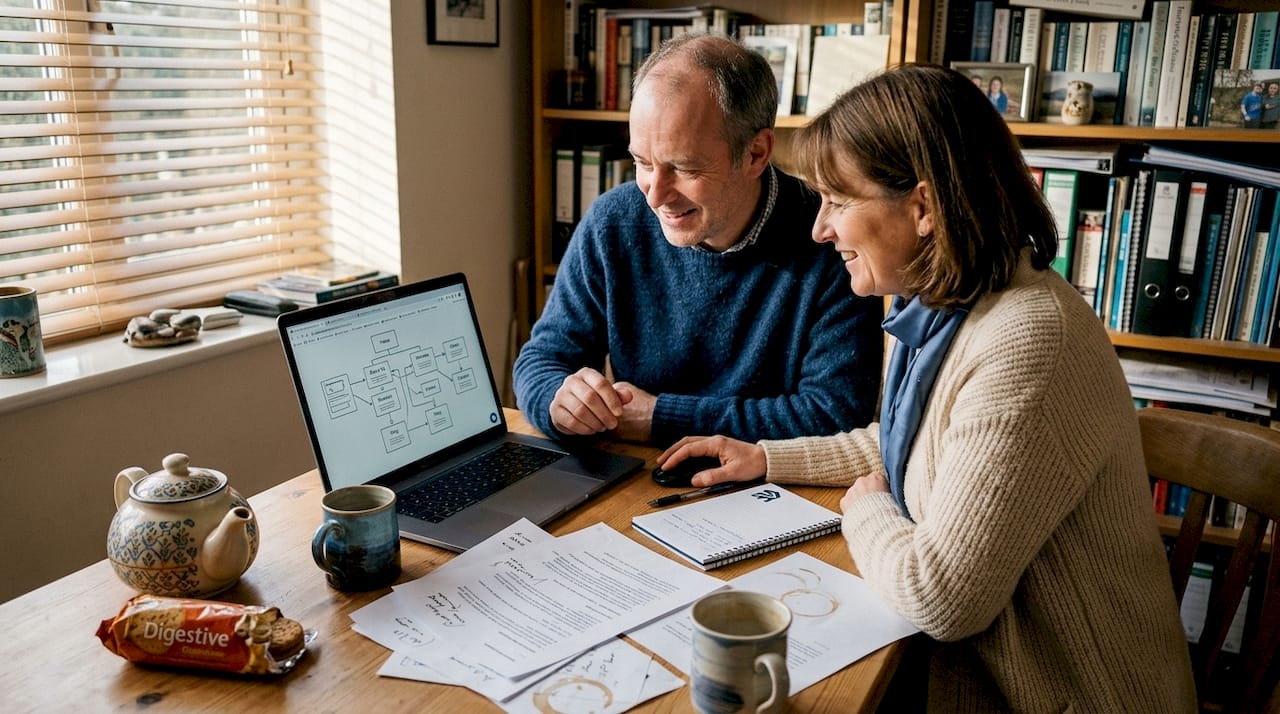
Think of internal links as signposts. If someone is reading your page about kitchen fitting services, a link to your page on kitchen design ideas makes logical sense. It adds value for the reader and tells Google that those two pages are related. For practical advice on putting this into action, the proven website optimisation strategies guide covers internal linking in the context of a wider site health plan.
Pro Tip: Use descriptive anchor text (the clickable words in a link). “Learn more” tells Google nothing. “Kitchen renovation cost guide” tells Google exactly where the link leads and why it is relevant.
Image optimisation is another area where many SME sites miss easy wins. Here are three techniques that make a real difference:
- Compress images before uploading. Large image files slow page load times, which hurts both rankings and user experience. Tools like Squoosh or TinyPNG reduce file size without visible quality loss.
- Always write descriptive alt text. Alt text is the written description of an image used by screen readers and search engines. “img_0045.jpg” is useless. “Freshly painted exterior of Victorian terrace in Bristol” is useful.
- Use modern file formats. WebP files are smaller than JPEG or PNG at the same visual quality, improving load speed without any compromise in appearance.
User engagement signals, such as how long visitors stay, how many pages they visit, and whether they click your calls to action, are increasingly important. A page that loads in under two seconds, uses clear headings, and has obvious next steps keeps people engaged. That engagement, in turn, supports stronger rankings over time.
Mobile-friendliness, speed, and technical on-page essentials
Even with visible page elements optimised, technical details can quietly undermine your rankings. Mobile-friendliness is not optional. Google uses mobile-first indexing, which means it predominantly uses the mobile version of your site to determine rankings. If your pages are awkward to navigate on a smartphone, you will struggle to compete regardless of how good your content is.
Core technical checks every UK SME should complete:
- HTTPS: Ensure your site has a valid SSL certificate. Google flags non-HTTPS sites as insecure, which reduces trust and can impact rankings.
- XML sitemap: Submit a sitemap to Google Search Console so Google can find and index all your pages efficiently.
- Robots.txt file: Make sure your robots.txt file is not accidentally blocking important pages from being crawled.
- Alt text on all images: As covered above, every image needs descriptive alt text for both SEO and accessibility.
- Canonical tags: Use canonical tags to tell Google which version of a page is the primary one, preventing duplicate content issues.
For a deeper look at the technical side, advanced technical SEO tactics explains how to address crawlability and indexation at a more granular level. The technical SEO essentials framework confirms that these basics, when ignored, create a ceiling on how well your content can rank.
Pro Tip: Prioritise the load speed of your above-the-fold content, meaning everything visible before the user scrolls. Google measures how quickly this section appears, and users form their impression of your site within the first second.
Common speed blockers to address:
- Uncompressed images taking up excessive bandwidth
- Too many third-party scripts (chat widgets, tracking pixels) loading simultaneously
- Slow web hosting that cannot handle modest traffic
- Render-blocking JavaScript that delays page display
- No browser caching set up for returning visitors
Page speed tools like Google PageSpeed Insights and GTmetrix give you a clear score and a prioritised list of fixes, making it straightforward to know where to start.
Our perspective: What most guides miss about on-page SEO
After working with UK SMEs across a wide range of sectors, a pattern emerges. Most business owners approach on-page SEO as a checklist. Tick the title tag box. Tick the alt text box. Move on. The problem is that a ticked box and a genuinely effective page are not the same thing.
The businesses that see lasting ranking improvements are the ones that treat each page as a resource for a real person with a specific problem. They write for the reader first, and then refine for search engines. The ones that struggle treat SEO as a mechanical exercise, obsessing over keyword density while producing content that nobody wants to read or share.
As we often tell clients, online success with an SEO consultant is rarely about finding a secret tactic. It is about consistently doing the straightforward things well and connecting your SEO work directly to what your business is actually trying to achieve.
The biggest on-page SEO mistake is optimising for Google’s algorithm instead of for the customer sat at their keyboard typing in a question they genuinely need answered.
Ready to implement powerful on-page SEO in your business?
Putting these techniques into practice takes time and a clear understanding of how each element connects. Getting the details right consistently is where most businesses benefit from professional support.
At Gregg King, we help UK SMEs implement SEO and website design service strategies that are built around your specific goals and market. Whether you want to understand the benefits of an SEO consultant or simply want your site to rank and convert better, we are here to help. Speak to a UK SEO consultant today for a free, no-obligation conversation about what is holding your site back and how to fix it.
Frequently asked questions
What is the most important on-page SEO factor?
Title tags matter most — optimise them to match search intent, place your keyword at the front, and keep them between 50 and 60 characters for the strongest results.
How many internal links should I add to a page?
Aim for 3 to 5 relevant internal links per page to help both users and search engines navigate your site more effectively.
How can I check if my site is mobile-friendly?
Use Google’s Mobile-Friendly Test tool or simply open your site on a smartphone and check whether text, images, and menus all display correctly without horizontal scrolling.
Should every image have alt text for SEO?
Yes, always add descriptive alt text to every image because it helps search engines understand your content and improves accessibility for users who rely on screen readers.
Recommended
- Top SEO strategies for UK businesses: boost your online reach
- Advanced Technical SEO Tactics to Boost Your Google Business Profile Rankings (UK Guide) – Gregg King SEO
- What is off-page SEO? Boost UK business visibility
- Understanding search rankings: clear strategies for UK businesses
- Ranking a High-Intent Affiliate Keyword in the UK with 22,000+ Monthly Searches – 1on1 SEO