
Most UK business owners know digital marketing matters. Yet a surprising number still feel overwhelmed by the jargon, unsure which channels to prioritise, or stuck spending money on tactics that deliver nothing measurable. The good news is that digital marketing offers measurability, targeting, and cost-effectiveness that traditional methods simply cannot match. This guide cuts through the noise. We will explain what digital marketing actually is, break down the core channels relevant to UK SMBs, and give you a practical framework for building a strategy that works for your business.
Table of Contents
- Digital marketing explained: what it is and why it matters
- Core digital marketing channels for UK businesses
- How digital marketing outperforms traditional strategies
- Planning your digital marketing strategy in the UK
- Common misconceptions and expert advice for UK SMBs
- How Gregg King SEO can help your UK business succeed online
- Frequently asked questions
Key Takeaways
| Point | Details |
|---|---|
| Digital channels defined | Digital marketing uses online platforms like search, social, email, and websites to reach UK customers. |
| Measurable impact | Results are trackable and ROI can be calculated, unlike traditional marketing methods. |
| Strategic planning essential | Building a digital marketing strategy starts with your website and local SEO, then integrates additional channels. |
| Avoid quick-fix promises | Growth is gradual; beware of guaranteed rankings or overnight success claims. |
| Expert help available | Specialists like Gregg King SEO can guide UK SMBs to maximise their digital presence. |
Digital marketing explained: what it is and why it matters
At its core, digital marketing is the promotion of products or services using digital channels. That includes search engines, social media platforms, email, your website, and paid advertising. It is not one single thing. It is a collection of tools and tactics that work together to get your business in front of the right people at the right time.
Traditional marketing, think newspaper adverts, leaflet drops, or radio spots, casts a wide net and hopes for the best. Digital marketing is different. You can target a 35-year-old woman in Manchester who searched for “emergency plumber” ten minutes ago. That level of precision is genuinely transformative for small businesses with limited budgets.
“Digital marketing allows businesses to reach specific audiences with measurable precision, something traditional channels have never been able to offer at an affordable scale.”
Here is a quick comparison of digital versus traditional marketing:
| Feature | Digital marketing | Traditional marketing |
|---|---|---|
| Targeting | Highly specific | Broad and general |
| Cost entry point | Low to moderate | Often high |
| Measurability | Real-time data | Difficult to track |
| Reach | Local to global | Mostly local or regional |
| Speed of results | Fast to moderate | Slow |
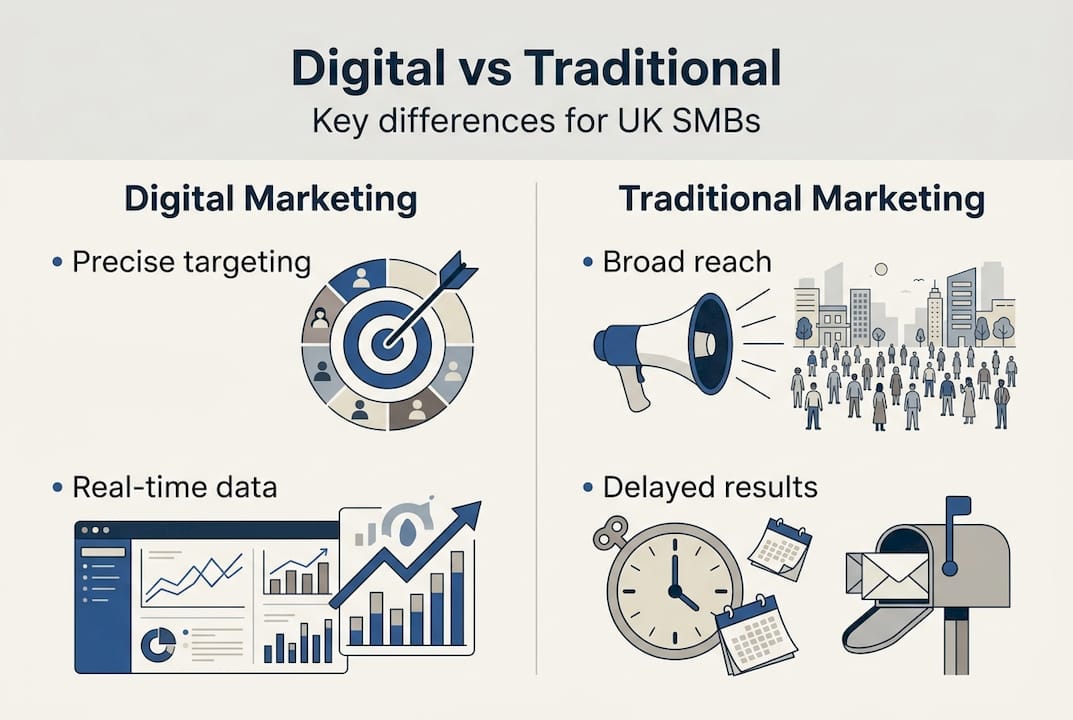
The table above makes it clear why so many UK SMBs are shifting their budgets online. You get more control, better data, and a far clearer picture of what is actually working.
Core digital marketing channels for UK businesses
Understanding the individual channels is where things get practical. Core methodologies include SEO, PPC, content marketing, social media, email, and local SEO, and each one serves a distinct purpose in your overall strategy.
Here is a breakdown of each channel and its primary strength:
| Channel | Primary strength | Best for |
|---|---|---|
| SEO | Organic visibility on search engines | Long-term traffic growth |
| PPC | Immediate paid traffic | Quick wins and promotions |
| Content marketing | Authority and trust building | Educating your audience |
| Social media | Engagement and community | Brand awareness |
| Email marketing | Nurturing and retention | Repeat customers |
| Local SEO | Geographic targeting | Foot traffic and local leads |
SEO (search engine optimisation) is the process of improving your website so it ranks higher in Google search results without paying for ads. It takes time but delivers compounding returns. If you want to go deeper, our technical SEO tips cover the more advanced side of this.

Local SEO is particularly powerful for UK SMBs. If you run a shop, a clinic, or any service-based business, appearing in local search results can directly drive footfall and phone calls. Many businesses are losing customers simply because of avoidable errors, and our guide on how to fix local SEO issues walks through the most common ones.
Email marketing often gets overlooked, but it consistently delivers one of the highest returns of any digital channel. A well-timed email to an existing customer costs almost nothing and can generate repeat business with minimal effort.
Pro Tip: Do not try to master every channel at once. Start with two or three that align with your business goals, get them working well, then expand. Spreading yourself too thin is one of the most common mistakes UK SMBs make.
For businesses ready to push further, our advanced SEO strategies outline what the most competitive UK businesses are doing right now to stay ahead.
How digital marketing outperforms traditional strategies
Let us be direct. A full-page advert in a local newspaper might cost hundreds of pounds and reach thousands of people, but you have no idea how many of them were actually interested in what you sell. Digital marketing flips this entirely.
With digital channels, you know exactly how many people saw your advert, clicked it, visited your website, and made a purchase. That is not an estimate. That is real data, available in real time.
- You can pause a campaign the moment it stops performing
- You can double your budget on an ad that is generating strong returns
- You can test two versions of a landing page and know within days which one converts better
- You can retarget someone who visited your website but did not buy
These capabilities simply do not exist in traditional marketing. Digital marketing offers measurability, targeting, and cost-effectiveness that gives UK SMBs a genuine competitive edge, even against much larger competitors.
“The businesses that grow fastest online are not necessarily the ones with the biggest budgets. They are the ones that measure everything and act on what the data tells them.”
Real UK businesses are already seeing this in action. Our SEO case studies show how SMBs across different sectors went from being invisible online to generating consistent inbound leads. The SEO business impact can be significant when the right strategy is applied consistently.
Planning your digital marketing strategy in the UK
Knowing the channels is one thing. Putting them together into a coherent plan is where most business owners get stuck. Here is a practical step-by-step approach:
- Define your goals. Are you trying to generate leads, increase online sales, or build brand awareness? Your goal shapes everything else.
- Audit your current online presence. Look at your website, your Google Business Profile, and your social media accounts. Where are the gaps? Our SEO audit steps give you a structured way to do this.
- Start with your website and local SEO. As UK digital strategy advice recommends, website optimisation and local SEO form the foundation of any effective digital strategy.
- Choose two or three channels to focus on. Based on your audience and goals, select the channels most likely to reach your ideal customers.
- Set a realistic budget. Digital marketing does not require enormous spend, but it does require consistency. Even a modest monthly budget, applied strategically, can deliver strong results.
- Measure and adjust. Use Google Analytics and Google Search Console to track performance. Review your data monthly and make changes based on what you find.
Pro Tip: If you operate in a regulated or specialist sector, such as legal services, your digital strategy needs to reflect that. Our solicitor SEO guide is a good example of how sector-specific approaches outperform generic ones.
Common misconceptions and expert advice for UK SMBs
There is no shortage of bad advice in digital marketing. Some of it is well-intentioned but outdated. Some of it is deliberately misleading. Here are the myths worth addressing directly.
Myth: Great content alone will get you to the top of Google.
Content matters enormously, but it is not the whole picture. Links from other reputable websites, your brand’s authority, and technical site health all play a role. SEO myths debunked: links, brand, and authority matter just as much as the words on your page.
Myth: You need to test everything before making a decision.
Data is valuable, but paralysis by analysis is real. Sometimes experienced judgement and a clear understanding of your customers will tell you more than weeks of A/B testing. Trust your instincts when the data is inconclusive.
Myth: Digital marketing delivers instant results.
SEO typically takes three to six months to show meaningful movement. Social media audiences take time to build. Email lists do not grow overnight. Anyone promising you page-one rankings in two weeks is not being honest with you.
- Be sceptical of guarantees around specific rankings
- Avoid agencies that cannot explain their methods clearly
- Look for transparent reporting and realistic timelines
“The most dangerous thing in digital marketing is not doing nothing. It is paying someone who promises everything and delivers nothing.”
If your business is not appearing in local searches, that is a specific and fixable problem. Our guide on near me search issues explains exactly why this happens and what you can do about it.
Pro Tip: Before hiring any digital marketing agency or consultant, ask them to show you results they have achieved for businesses similar to yours. Vague case studies and generic testimonials are red flags.
How Gregg King SEO can help your UK business succeed online
Putting digital marketing into practice takes time, expertise, and consistency. Most business owners are already stretched managing day-to-day operations, and that is where having an experienced partner makes a real difference.
At Gregg King SEO, we have spent over 20 years helping UK SMBs build strong, sustainable online presences. Whether you need Google Business Profile optimisation to dominate local search, a fully integrated SEO and website design solution, or guidance on advanced SEO strategies to outperform your competitors, we tailor everything to your specific business and sector. We do not offer one-size-fits-all packages. We offer honest, measurable results. Get in touch today for a free consultation and find out exactly where your biggest online opportunities lie.
Frequently asked questions
What is digital marketing, in simple terms?
Digital marketing uses digital channels to promote your business online, including search engines, websites, social media, and email. It gives you precise control over who sees your message and how much you spend.
Which digital marketing channel should UK small businesses start with?
Website optimisation and local SEO form the strongest foundation, as they help customers find you when they are actively searching for what you offer.
How can I measure digital marketing ROI for my business?
Digital marketing offers measurability through tools like Google Analytics, which track website visits, conversions, and campaign performance in real time, giving you a clear picture of what is generating returns.
Can digital marketing guarantee instant results?
No. Sustainable digital growth takes months of consistent effort. Be cautious of any provider promising guaranteed rankings or overnight success, as these claims are almost always misleading.
Recommended
- How Social Media Helps Businesses in The UK – Gregg King SEO
- How to Run a 2026 SEO Audit: Step-by-step to Uncover Growth for UK Businesses – Gregg King SEO
- Advanced SEO Strategies UK Businesses Must Adopt in 2026 – Gregg King SEO
- Advanced Technical SEO Tactics to Boost Your Google Business Profile Rankings (UK Guide) – Gregg King SEO