
TL;DR:
- Local SEO improves visibility, attracts qualified local customers, and builds community trust.
- Combining Google Business Profile optimization, website local keywords, and consistent citations is essential.
- Ongoing efforts like reviews and profile updates create sustainable long-term local search success.
You’ve built your business, set up a website, and even listed yourself on a couple of directories. Yet when a local customer searches for exactly what you offer, your competitor appears at the top and you’re nowhere to be seen. It’s one of the most frustrating experiences for UK small business owners, and it happens more often than you might think. The difference isn’t always budget or brand size. It usually comes down to local SEO: a targeted, practical approach to making your business visible to people searching in your area. This guide breaks down everything you need to know.
Table of Contents
- What is local SEO and why does it matter?
- How local SEO works: The main components
- Google Business Profile: The cornerstone of local SEO
- Building your local reputation: Reviews and citations
- Why local SEO rewards consistency and long-term thinking
- Ready to accelerate your local results?
- Frequently asked questions
Key Takeaways
| Point | Details |
|---|---|
| Local SEO drives visibility | Appearing in local searches helps your business attract high-intent customers from your area. |
| Google Business Profile is vital | A well-optimised Google Business Profile can put your business ahead of competitors on maps and local packs. |
| Trust grows with reviews | Consistent, quality customer reviews improve both search rankings and community reputation. |
| Consistency is key | Keeping business information and local activity up to date gives lasting results and stronger rankings. |
What is local SEO and why does it matter?
Local SEO (search engine optimisation) is the practice of improving your online presence so your business appears prominently when people nearby search for your products or services. Unlike broader SEO, which targets national or global audiences, local SEO focuses on specific geographic areas. Think searches like “plumber in Manchester” or “best café near me.”
Where general SEO might target broad keywords across an entire industry, local SEO targets location-based intent. Google responds to these searches by showing a “Map Pack”: a cluster of three local businesses displayed alongside a map, right at the top of the results page. Getting into that Map Pack is one of the most valuable things you can do for a community-facing business.
The benefits for small and medium-sized UK businesses are significant. Three outcomes stand out most:
- Higher visibility: Your business appears in front of people who are actively looking for what you offer, right now, nearby.
- Better-qualified traffic: Local searchers have strong purchase intent. They’re not browsing; they’re ready to act.
- Stronger community trust: Appearing consistently in local results signals credibility. Customers trust businesses that show up repeatedly in search.
“Local SEO is a long-term, sustainable strategy,” often contrasted with the immediate but ongoing cost of paid ads, which stop delivering the moment you stop spending.
One area that directly feeds into local visibility is your Google Business Profile optimisation. Getting this right signals to Google that your business is legitimate, active, and relevant to nearby searchers.
Pro Tip: Consistency of your business name, address, and phone number across all online directories is a major ranking factor. Even small discrepancies (like “St.” vs “Street”) can undermine your local rankings. If you want expert support with this, our profile optimisation service ensures every detail is accurate and working in your favour.
How local SEO works: The main components
Once you grasp why local SEO matters, it’s time to examine what actually drives local search results. Local SEO sits on three pillars, and you need all three working together.
On-page signals refer to your website content. This includes using location-specific keywords on your service pages, having your business address on your site, and creating locally relevant content that Google can read and understand.
Off-page signals include citations (mentions of your business on other websites) and customer reviews. The more consistently your business appears across trusted directories, and the more positive reviews you earn, the stronger your local authority becomes.

Google Business Profile (GBP) is perhaps the most immediately impactful. It powers the Map Pack results and often appears before your website in search. While some businesses prioritise GBP over a website, integrated strategies that combine both consistently outperform either alone.
| Factor | Local SEO | Paid ads | Traditional advertising |
|---|---|---|---|
| Cost over time | Low (ongoing effort) | High (per click) | High (per campaign) |
| Sustainability | Long-term | Short-term | Short-term |
| Visibility | Organic, trusted | Sponsored label | Offline/limited |
| Lead quality | High (local intent) | Variable | Variable |
Here are the core actions to build your local SEO:
- Set up and verify your Google Business Profile
- Optimise your website pages with local keywords and your business address
- Build location citations across relevant UK directories
- Actively encourage and respond to customer reviews
- Create locally relevant content on your site or blog
If you want GBP management help or are ready to explore advanced local SEO tactics, these resources will give you a strong foundation to build from.
Google Business Profile: The cornerstone of local SEO
The most powerful tool in your local SEO toolkit is your Google Business Profile. Let’s break down how to get it right.
GBP often appears before your own website in local search results, particularly in the Map Pack. This means that even if your site is well-designed, a neglected or incomplete profile can cost you visibility before customers even reach your homepage.
Some business owners prioritise GBP over their website, especially in the early stages. While that approach has merit, combining a complete GBP with a well-optimised site delivers the strongest results.
A winning profile includes:
- Accurate business name, address, and phone number that match everywhere else online
- Relevant primary and secondary categories (avoid stuffing irrelevant ones)
- High-quality photos of your premises, team, and products or services
- Regular posts and updates to show Google your profile is active
- FAQ section with genuine questions customers ask
- Responses to all reviews, both positive and negative
Understanding the importance of Google Business Profile is the first step. The five most common mistakes businesses make are: mismatched contact information across platforms, leaving the account unverified, uploading no images at all, ignoring reviews completely, and choosing categories that don’t reflect their actual services.
Pro Tip: Update your business hours and services whenever anything changes. Outdated information can lead Google to deprioritise your listing, and in some cases, it can trigger a profile suspension. If you need help with GBP setup or want a proven GBP optimisation guide, both resources will save you considerable time and guesswork.
Building your local reputation: Reviews and citations
With your core local SEO set up, focus shifts to reputation and authority, both essential for standing out in local packs.
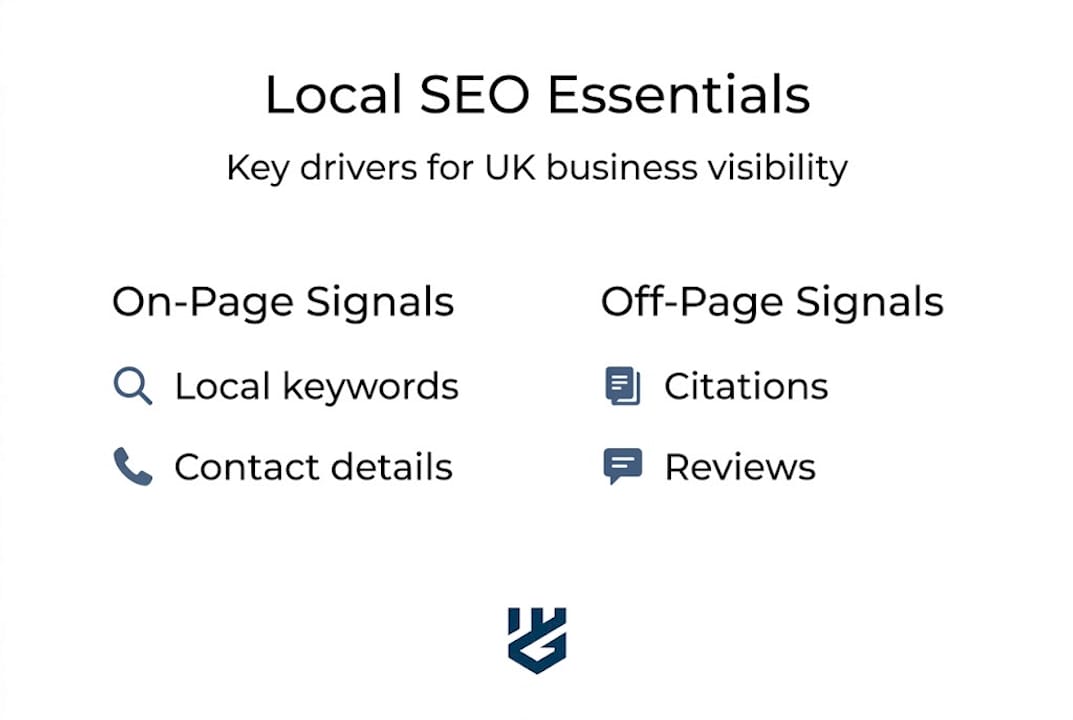
In local SEO, a citation is any online mention of your business name, address, and phone number, commonly referred to as NAP. Citations appear in business directories, review platforms, local news sites, and industry listings. The more consistent and widespread they are, the more confident Google becomes in your business’s legitimacy.
Here are key UK directories worth targeting:
| Directory | Features | Reviews |
|---|---|---|
| Yell | Paid and free listings, strong UK presence | Yes |
| Thomson Local | Established UK directory, local search focus | Yes |
| Bing Places | Supports Bing local search | Limited |
| Trustpilot | Strong review credibility | Yes |
| Checkatrade | Trades and local services focus | Yes |
Customer reviews do more than build trust. They directly influence your Map Pack rankings. Quantity matters, but quality and recency matter more. A business with 12 detailed reviews from the past month will often outrank one with 80 older reviews and no recent activity.
Tactics for earning more quality reviews:
- Ask at the moment of satisfaction: Right after a job is done or a product delivered, that’s when customers are most likely to leave feedback.
- Send a follow-up message with a direct link to your review page.
- Train your team to mention reviews naturally in conversation.
- Respond to every review, which signals to both Google and future customers that you’re engaged.
Integrated approaches using Google Business Profile and your website together yield the most reliable local results, especially when paired with consistent citation building.
If you’re unsure where to start with all of this, working with an SEO consultant can help you prioritise the actions that will move the needle fastest for your specific business and location.
Why local SEO rewards consistency and long-term thinking
Here’s something most articles won’t tell you plainly: the businesses that dominate local search aren’t necessarily the ones who started strongest. They’re the ones who kept going.
We’ve seen businesses launch a Google Business Profile with brilliant photos, earn 20 reviews in the first month, and then go completely quiet. Six months later, they wonder why a competitor with a less polished profile has overtaken them. The answer is almost always consistency. Google notices when you stop. Your community does too.
Paid ads can absolutely deliver immediate visibility, but local SEO offers sustainable advantages that compound over time. Every review you earn, every citation you build, every post you publish adds a layer to your local authority. Unlike ad spend, that work doesn’t disappear when you pause.
The real discipline is treating local SEO the way you’d treat your customer service or your accounts: something you check regularly, not only when something goes wrong. Our all-in-one UK marketing guide shows how this fits into a broader strategy that keeps your business growing steadily.
Pro Tip: Schedule a monthly 30-minute check-in for your GBP and key directory listings. Update photos, respond to new reviews, and check that your business details are still accurate. Small, regular actions compound into a strong local presence.
Ready to accelerate your local results?
Local SEO works best when your Google Business Profile, website, and online reputation all support one another. Getting one element right is a start. Getting all three working together is what separates the businesses that appear consistently in local search from those that rarely show up at all.
At Gregg King, we’ve spent over 20 years helping UK businesses build exactly that kind of joined-up local presence. Whether you need a fully managed GBP optimisation service, a complete overhaul of your SEO and website design, or ongoing profile management support, we tailor everything to your business, your location, and your goals. Get in touch for a free consultation and let’s map out your local growth together.
Frequently asked questions
Is local SEO better than paid ads for small businesses?
Local SEO is more sustainable and cost-effective over the long term, while paid ads deliver quick but temporary results that stop the moment your budget runs out.
How can I get my business in the top local search results?
Focus on optimising your Google Business Profile, collecting fresh reviews regularly, and keeping your business details consistent across all directories, as integrated approaches using GBP, your website, and citations together yield the best results.
Do I need a website if I have a Google Business Profile?
While some businesses appear in local search with only a profile, integrated GBP and website strategies consistently deliver stronger and more reliable local visibility.
What are the biggest mistakes in local SEO?
Inconsistent business details across directories, an unverified or incomplete Google Business Profile, and too few reviews are the most common pitfalls that hold UK businesses back from local rankings.
Recommended
- Top SEO strategies for UK businesses: boost your online reach
- Advanced Technical SEO Tactics to Boost Your Google Business Profile Rankings (UK Guide) – Gregg King SEO
- Optimise your website: proven strategies for UK business
- Why you’re not showing up for “near me” searches: 11 local SEO issues costing UK businesses high‑intent customers – Gregg King SEO
- Optimise your content localisation process: 1.5x conversions