
TL;DR:
- Effective SEO content attracts the right visitors by focusing on clear keywords and user intent.
- Proper on-page elements, structure, and regular updates boost search visibility and rankings.
- Genuine, helpful content based on real experience outperforms manipulative SEO tricks long-term.
Your website is live, your services are excellent, and yet the enquiries aren’t coming in. Sound familiar? For many UK small and medium-sized business owners, the problem isn’t the product — it’s the content. Weak, unfocused pages fail to attract the right visitors, and without a clear SEO content strategy, even a well-designed site can sit invisible in search results. The good news is that writing effective SEO content is a learnable skill. This guide walks you through everything you need, from preparation and writing to measuring results, so you can start attracting the right customers online.
Table of Contents
- What you need before you start writing SEO content
- Step-by-step: how to write SEO content that works
- Optimising on-page elements for maximum impact
- Avoiding common SEO content mistakes
- Measuring results and refining your SEO content
- Why people-first SEO content outperforms ‘SEO tricks’
- Get expert help with your SEO content
- Frequently asked questions
Key Takeaways
| Point | Details |
|---|---|
| Start with strong research | Know your audience and keywords before you write a single word. |
| Structure content clearly | Use headings, lists, and short paragraphs to make content easier to read and rank. |
| Optimise for users and search | Fine-tune titles, meta descriptions, and images for both people and algorithms. |
| Avoid SEO shortcuts | Focus on answering real questions rather than chasing algorithm tricks. |
| Measure and improve | Track your SEO content performance and update it regularly for best results. |
What you need before you start writing SEO content
Now that you know where effective SEO content can take your business, let’s cover what you need in place to get started. Jumping straight into writing without preparation is one of the most common mistakes UK business owners make. A little groundwork saves a lot of wasted effort.
Keyword research is your starting point. You need to know what your ideal customers are actually typing into Google, not what you assume they’re searching for. Free tools like Google Keyword Planner and paid options like Semrush or Ahrefs help you identify search volumes and competition levels. Group your keywords by intent: are people looking to buy, to learn, or to compare?
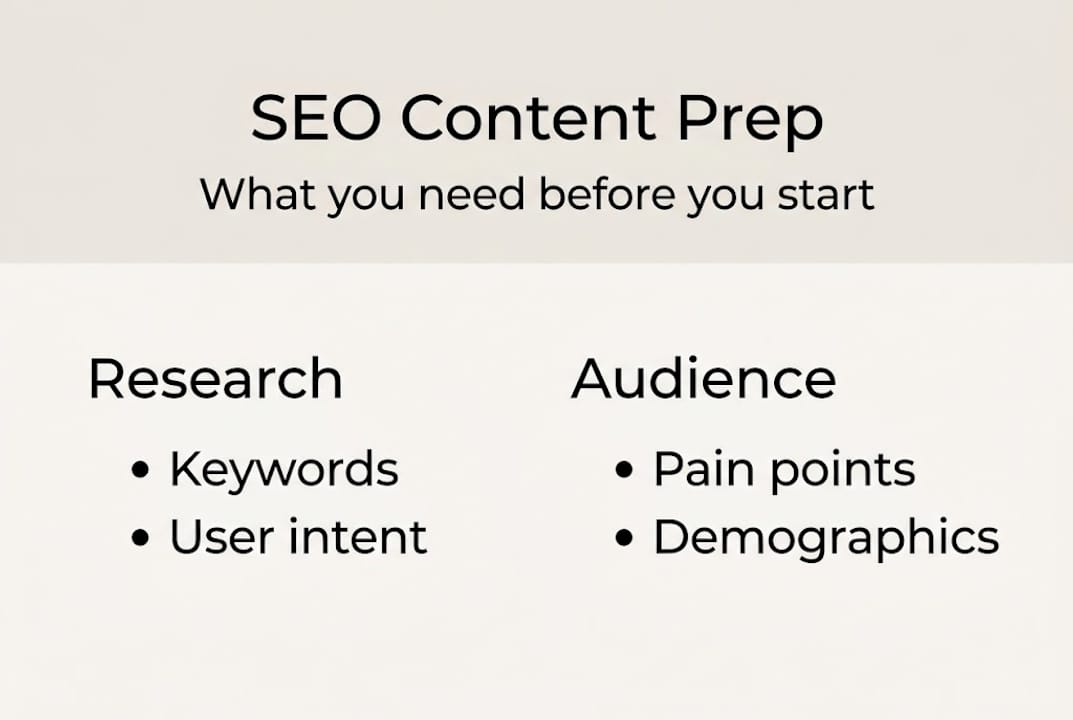
Understanding user intent matters just as much as the keywords themselves. Before you write a single word, study the top results for your target search term. Are they blog posts, product pages, or FAQs? The format Google rewards tells you what format your content should take.
Here’s a quick overview of the tools worth having:
| Tool type | Example tools | Purpose |
|---|---|---|
| Keyword research | Google Keyword Planner, Ahrefs | Find target keywords and volumes |
| Site audit | Screaming Frog, Semrush | Spot technical issues |
| Content editor | Surfer SEO, Clearscope | Optimise content structure |
| Speed check | Google PageSpeed Insights | Test mobile and desktop performance |
You also need a clear picture of your audience. Who are you writing for? What problems keep them up at night? Knowing your ideal customer profile shapes every word you write. Pair this with a solid technical foundation: your site must be mobile-friendly, load quickly, and use HTTPS. As the SEO content optimisation guide outlines, on-page elements like titles, meta descriptions, and fast page speed are core mechanics that underpin everything else. Understanding the SEO consultant benefits of getting this foundation right early can save months of rework. Google’s own AI search preparation guidance also confirms that structured, well-prepared content performs better across both traditional and AI-powered search.
Pro Tip: Stick to one or two core topics per page. Trying to target five different keywords on a single page dilutes your focus and confuses both readers and search engines.
Step-by-step: how to write SEO content that works
With your tools ready and audience known, it’s time to dive into practical content creation. The process is more straightforward than most people expect, provided you follow a logical sequence.
- Choose your topic and primary keyword. Pick one main keyword per piece of content and make sure it reflects genuine search demand.
- Research search intent and top SERP features. Look at what Google currently ranks for your keyword. Note whether featured snippets, FAQs, or video results appear.
- Draft a compelling title and meta description. Your title should be under 60 characters and include your keyword naturally. Your meta description should summarise the page value in under 160 characters.
- Outline with logical headings. Use H2 and H3 headings to break up your content. Weave in related keywords naturally, never forced.
- Write clear, people-first content. Answer the reader’s question directly and thoroughly. Avoid padding sentences just to hit a word count.
- Add structure with lists, tables, and images. Visual variety improves readability and increases your chances of appearing in featured snippets.
- Interlink to relevant internal pages. Connecting related content on your site builds authority and helps visitors navigate to what they need next.
A useful comparison when planning your content approach:
| Content type | Primary goal | Key focus |
|---|---|---|
| Business service page | Convert visitors | Clear benefits, trust signals, calls to action |
| Blog post | Educate and attract | Depth, examples, keyword coverage |
For comprehensive SEO content, structure is everything. Short paragraphs, bold subheadings, and an inverted pyramid style — where you lead with the answer — all improve both readability and AI snippet extraction, as outlined in guidance on how to write for SEO. If you want to go further, exploring advanced SEO strategies can sharpen your competitive edge considerably.
Pro Tip: Place your key answer or insight within the first two paragraphs of any section. This increases your chances of being pulled into Google’s featured snippets and AI Overviews.
Optimising on-page elements for maximum impact
Now, to maximise the reach and performance of your drafted content, you need to fine-tune critical on-page elements. These are the technical details that many business owners overlook, yet they make a significant difference to how search engines interpret and rank your pages.

Title tags and meta descriptions are your first impression in search results. Keep title tags under 60 characters and include your primary keyword near the front. Meta descriptions should stay under 160 characters and give users a clear reason to click through.
Your heading hierarchy matters for both skimmability and SEO. Use one H1 per page (usually your title), H2s for main sections, and H3s for subsections. This structure helps Google understand your content’s organisation.
Here are the key on-page elements to optimise:
- Title tag: Under 60 characters, keyword near the start
- Meta description: Under 160 characters, benefit-focused
- H1: One per page, matches search intent
- H2/H3 headings: Logical hierarchy, natural keyword use
- Image alt text: Descriptive, keyword-relevant where appropriate
- Internal links: Connect related pages with descriptive anchor text
- Page speed: Aim for under three seconds on mobile
- Mobile layout: Test on multiple screen sizes
Image optimisation is frequently neglected. Compress image file sizes to improve load speed, use descriptive file names, and always write meaningful alt text. This helps visually impaired users and gives search engines additional context.
The SEO content optimisation guide confirms that well-structured content with proper on-page elements improves visibility across both traditional search and AI-powered results. Google’s AI search optimisation guidance notes that clear summaries and structured pages are increasingly cited in AI Overviews, with well-optimised content seeing up to a 23 to 25 per cent improvement in snippet and AI visibility. You can explore the full range of support available through SEO and web services if you need hands-on help with these technical elements.
Avoiding common SEO content mistakes
Mistakes can undermine even the most well-intentioned efforts, so let’s identify common traps and best practices. Knowing what to avoid is just as valuable as knowing what to do.
Here are the pitfalls that catch UK business owners most often:
- Keyword stuffing: Repeating your target keyword unnaturally throughout the page no longer fools Google and actively harms readability. Aim for natural placement.
- Copying competitors: Rewriting what already ranks might seem efficient, but it adds nothing new. Bring your own experience, examples, and perspective.
- Neglecting E-E-A-T: Google evaluates your content for Experience, Expertise, Authoritativeness, and Trustworthiness. Missing author bios, thin sourcing, and a lack of original analysis all weaken your standing.
- Publishing AI-only content: AI writing tools can speed up drafting, but content published without human review and genuine insight loses trust and rankings over time.
- Ignoring mobile and page speed: A slow, hard-to-navigate mobile experience pushes visitors away before they’ve read a word.
As the E-E-A-T guidance makes clear, demonstrating real experience through author bios, reliable citations, and original analysis is now a fundamental ranking factor, not an optional extra. Avoiding AI-only content without human oversight is particularly important in 2026, as Google’s systems have become far better at identifying shallow, unverified material.
“The businesses that consistently rank well are those that genuinely help their customers. Every piece of content should answer a real question from a real person.”
If you’re unsure whether your current content meets these standards, using an SEO consultant for an honest audit can reveal gaps you might not spot yourself.
Measuring results and refining your SEO content
Once your content is live, maintaining momentum means ongoing measurement and refinement. Publishing and walking away is a missed opportunity. The data available to you is genuinely useful, and acting on it separates businesses that grow from those that plateau.
Focus on these key metrics:
- Google Search Console: Track impressions, clicks, average position, and which queries bring traffic to each page
- Google Analytics: Monitor time on page, bounce rate, and conversion actions
- Manual SERP checks: Search your target keywords periodically to see where you appear and what competitors are doing
- AI Overview tracking: Note whether your content appears in AI-generated answers, as this is becoming an increasingly valuable source of visibility
Older content deserves regular attention too. A page that ranked well two years ago may have slipped because newer, better content has emerged. Refreshing it with updated statistics, new FAQs, or improved structure can restore and even improve its position. As succeeding in AI search guidance confirms, clear summaries and strong E-E-A-T signals help content perform across both traditional rankings and AI-powered results. You can track SEO improvements more effectively by tying content updates to specific date-stamped records so you can see what changes made a difference. A practical example of this in action is the SEO for solicitors case study, which shows how consistent measurement and refinement drove real results.
Pro Tip: Set a calendar reminder every quarter to review your top ten pages. If traffic or rankings have stalled, update the content before considering more drastic changes.
Why people-first SEO content outperforms ‘SEO tricks’
Stepping back, what separates businesses that build lasting visibility from those that flop? In over 20 years of working in SEO, the answer is almost always the same: the businesses that win are the ones that genuinely try to help their customers.
SEO tricks — thin content, exact-match keyword cramming, manipulative link schemes — do occasionally produce short-term gains. But Google’s algorithm updates have become remarkably good at identifying and penalising these tactics. The risk simply isn’t worth it.
As people-first content research shows, human synthesis and genuine expertise consistently outperform AI-generated content that lacks real insight. Tools are useful for research and structure, but they can’t replicate your direct experience of serving your customers. That experience is your competitive advantage. Write from it.
The businesses I see struggling most are those chasing the latest algorithm hack rather than asking: “Does this actually answer my customer’s question better than anyone else?” Challenge yourself to write for people first, and the rankings will follow. For further perspective, SEO consulting insights explore why this approach consistently delivers long-term results.
Get expert help with your SEO content
Getting SEO content right takes time, ongoing skill, and a willingness to keep learning as search evolves. If you’re already stretched running your business, finding the hours to research, write, optimise, and measure can feel impossible.
That’s where we come in. At Gregg King, we offer tailored SEO & web design service solutions built specifically for UK small and medium-sized businesses. Whether you need a full site audit, hands-on content optimisation, or an ongoing SEO partner, we have the experience to help. Browse our full range of SEO services to find the right fit, or get in touch for a free consultation to discuss exactly where your content needs the most attention.
Frequently asked questions
What is the most important SEO content element for beginners?
Start by choosing the right target keyword and matching your content to what users actually want to find. Getting this core SEO mechanic right underpins everything else you build.
How do I measure if my SEO content is working?
Check for improvements in Google rankings, impressions, and traffic using Search Console and Google Analytics. Monitoring these key metrics consistently gives you a reliable picture of progress.
Can I use AI tools to write SEO content?
Yes, but all AI-generated content should be reviewed and enhanced by a human to add expertise and build trust. AI content without human oversight risks appearing shallow and losing rankings over time.
How often should SEO content be updated?
Review and refresh your SEO content at least every six months to maintain accuracy and competitiveness. Regularly updating content with new data and improved structure keeps pages relevant and ranking.
How long should SEO content be in 2026?
Aim for enough depth to cover the topic thoroughly, usually 800 to 2,000 words for most business pages. Focus on comprehensive content that fully answers the user’s question rather than hitting an arbitrary word count.
Recommended
- Understanding search rankings: clear strategies for UK businesses
- SEO audit checklist UK: Actionable steps to boost rankings
- Optimise your website: proven strategies for UK business
- How to Run a 2026 SEO Audit: Step-by-step to Uncover Growth for UK Businesses – Gregg King SEO
- 4 Steps To Hiring An SEO Expert For Your Marketing Agency | Remote Talent LATAM