TL;DR:
- Ongoing SEO monitoring is essential for sustained UK SME growth and visibility.
- Key metrics include organic conversions, keyword rankings, CTR, Core Web Vitals, and local profile insights.
- Regular use of free tools like Google Search Console and Analytics 4 helps identify issues and capitalize on opportunities.
Most UK SME owners treat SEO like a boiler service: get it done once, then forget about it until something breaks. That mindset is quietly costing businesses real revenue. With 46-72% of UK consumers searching locally before making a purchase decision, and mobile search now dominating how people find services, the businesses winning online are those watching their numbers every single month. This article walks you through what SEO performance actually means, which metrics deserve your attention, which tools make monitoring straightforward, and how to sidestep the mistakes that keep most SMEs invisible in search results.
Table of Contents
- What is SEO performance and why does it matter?
- Key metrics to monitor for UK SME SEO success
- Tools and resources for tracking SEO performance
- Common pitfalls and how to avoid blind spots
- Our take: Transforming SEO monitoring from chore to growth driver
- Ready to make your SEO work harder for you?
- Frequently asked questions
Key Takeaways
| Point | Details |
|---|---|
| Track actionable SEO metrics | Focus on conversions, local search, and mobile UX for measurable business growth. |
| Use the right tools | Google Analytics 4, Search Console, and simple audits let you catch hidden SEO issues fast. |
| Avoid vanity traps | Don’t rely on impressions—monthly monitoring of valuable metrics outperforms paid ads over time. |
| Make SEO monitoring strategic | Treat monthly SEO reviews as a business driver, not just maintenance, to build lasting competitiveness. |
What is SEO performance and why does it matter?
SEO performance is not a single score or a one-off achievement. It is the ongoing health of your website’s ability to attract the right visitors from search engines, convert them into enquiries or sales, and sustain that visibility over time. For a UK SME, that translates directly into phone calls, footfall, and revenue.
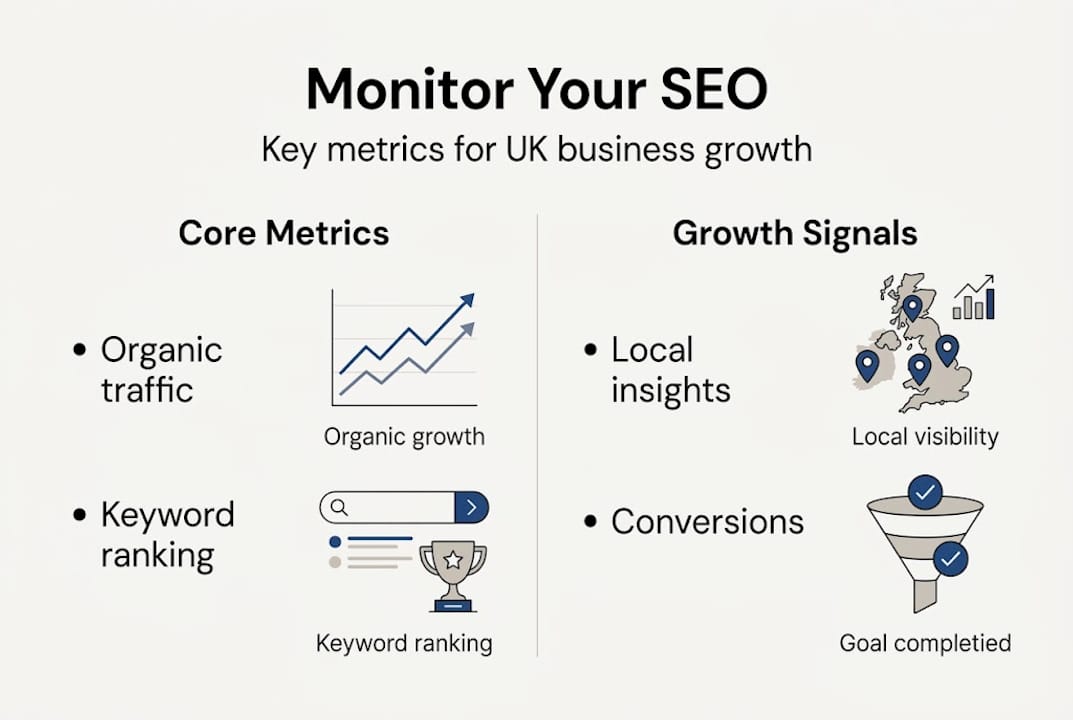
Monitoring SEO performance allows SME owners to track key metrics like organic traffic, keyword rankings, click-through rate (CTR), conversions, and Core Web Vitals. Each of these tells a different part of the story. Organic traffic shows how many people arrive via search. Keyword rankings reveal where you sit for the terms your customers actually type. CTR tells you whether your listing is compelling enough to earn the click. Conversions confirm whether visitors are taking the action you want.
Core Web Vitals deserve a special mention. These are Google’s technical measurements of how fast and stable your pages feel to a user. Poor scores here can suppress your rankings even if your content is excellent. Think of them as the structural survey on a house: everything might look fine from the outside, but hidden problems will affect the value.
The metrics worth tracking regularly include:
- Organic traffic (visitors arriving from search, not paid adverts)
- Keyword rankings (your position for target search terms)
- Click-through rate (percentage of searchers who click your listing)
- Organic conversions (enquiries, purchases, or calls from organic visitors)
- Core Web Vitals (page speed, visual stability, and interactivity scores)
- Bounce rate (visitors who leave without engaging further)
“SEO is not a sprint. It is a discipline. The businesses that monitor consistently are the ones that compound their gains month after month.”
Unlike paid advertising, where visibility disappears the moment you stop spending, SEO builds sustainable momentum. Working with an experienced SEO consultant helps you interpret these metrics in context and prioritise the actions that move the needle fastest for your specific sector and location.
Key metrics to monitor for UK SME SEO success
Not all metrics are created equal. Many SME owners get distracted by impressive-looking numbers that do not actually reflect business growth. Here is how to focus on what genuinely matters.
Organic conversions sit at the top of the priority list. A thousand extra visitors mean nothing if none of them pick up the phone or complete a purchase. Prioritise organic conversions over vanity metrics, and monthly monitoring turns SEO into a growth engine. Set up goal tracking in Google Analytics 4 so every form submission, call click, or checkout is recorded against organic search traffic.

For local businesses, the picture gets more specific. Track local metrics such as Google Business Profile (GBP) insights and ‘near me’ rankings, because mobile UX is vital as 60%+ of searches are now mobile. Your GBP insights show how many people viewed your profile, requested directions, or called directly from the listing. These numbers often reveal more about local buying intent than your website analytics alone.
| Metric | What it measures | Why it matters for SMEs |
|---|---|---|
| Organic conversions | Enquiries and sales from search | Direct revenue indicator |
| Keyword rankings | Position for target terms | Visibility and competitiveness |
| CTR | % of impressions that become clicks | Quality of title and meta description |
| Core Web Vitals | Page speed and stability | Google ranking factor |
| GBP insights | Local profile engagement | Local customer acquisition |
| Mobile bounce rate | Mobile visitor engagement | UX quality on smartphones |
Here is a practical sequence for monthly monitoring:
- Check organic conversions in Google Analytics 4
- Review keyword position changes in Search Console
- Examine GBP insights for calls, direction requests, and views
- Assess Core Web Vitals in Search Console’s Experience report
- Compare CTR for your top pages and test new title tags where needed
Pro Tip: Do not just track whether your rankings went up or down. Look at which pages gained or lost traffic and investigate why. A single page dropping from position 4 to position 11 can cost you 60% of its previous clicks overnight.
Understanding SEO keyword growth and the advantages of website optimisation gives you a fuller picture of how these metrics interact and where to focus your energy.
Tools and resources for tracking SEO performance
Understanding which metrics matter is only the start. Here is how to monitor them using practical tools and checks that do not require a technical background.
Google Search Console is your first port of call. It is free, connects directly to Google’s data, and shows exactly which queries bring visitors to your site, how often your pages appear, and your average position. It also flags crawl errors, mobile usability issues, and Core Web Vitals problems. Monitoring tools like Google Analytics 4 and Search Console enable data-driven improvement that would otherwise require expensive guesswork.
Google Analytics 4 (GA4) sits alongside Search Console and tracks what visitors do once they land on your site. You can see which pages convert, where people drop off, and how mobile users behave compared to desktop visitors. The two tools work best together: Search Console tells you how people found you, GA4 tells you what happened next.
| Tool | Cost | Best for | Skill level needed |
|---|---|---|---|
| Google Search Console | Free | Rankings, CTR, crawl issues | Beginner |
| Google Analytics 4 | Free | Traffic behaviour, conversions | Beginner to intermediate |
| Google Business Profile | Free | Local visibility, calls, reviews | Beginner |
| Screaming Frog | Free up to 500 URLs | Technical site audits | Intermediate |
| Ahrefs / Semrush | Paid | Competitor analysis, backlinks | Intermediate to advanced |
Regular audits reveal issues such as crawl errors and slow page speeds that suppress rankings without any obvious warning signs. A monthly audit does not need to be exhaustive. Start with:
- Checking Search Console for new errors or manual actions
- Running a speed test on your homepage and key landing pages
- Reviewing your GBP for unanswered reviews or outdated information
- Confirming your top five pages are still indexed correctly
Pro Tip: Set up a simple monthly spreadsheet to record your key numbers each time you check. Trends matter far more than single data points. A ranking that dips one month and recovers the next is normal. A ranking that slides steadily over four months signals a real problem.
For a structured approach, our SEO audit checklist walks you through the process step by step, and our website optimisation strategies guide covers the fixes that typically deliver the fastest improvements.
Common pitfalls and how to avoid blind spots
Even with the right tools, many UK SMEs miss out by falling into common traps. Here is how to avoid these costly errors.
The most widespread mistake is tracking the wrong numbers. Impressions look impressive in a report, but if nobody clicks and nobody converts, they are decorative. Focusing on total visitors without segmenting organic from paid or direct traffic leads to equally misleading conclusions. Always separate your data sources.
Without monitoring, businesses operate blindly, missing issues and competitor shifts. Regular audits uncover hidden problems that lower rankings. A page that loads slowly on mobile, a broken internal link, or a duplicate title tag can each quietly drag your visibility down without triggering any obvious alarm.
Common blind spots to address include:
- Ignoring competitor movements: If a rival improves their content or earns new backlinks, your relative position drops even if your own metrics stay flat
- Missing algorithm updates: Google updates its ranking systems regularly. Not knowing when an update rolled out makes it impossible to diagnose a sudden traffic drop
- Neglecting local signals: Outdated GBP information, inconsistent business name and address details across directories, or unanswered negative reviews all suppress local rankings
- Skipping mobile testing: A site that looks fine on desktop may be unusable on a smartphone, which now accounts for the majority of searches
“The businesses that suffer most from algorithm updates are the ones that were not paying attention before the update hit.”
Pro Tip: Set a Google Alert for your brand name and your main competitors. It takes two minutes to set up and gives you an early warning when something changes in your competitive landscape.
Addressing local SEO issues and understanding why you may not appear in near me searches are two areas where many SMEs lose significant ground without realising it. Pairing that with a clear understanding of search ranking strategies gives you a far stronger foundation.
Our take: Transforming SEO monitoring from chore to growth driver
Here is something most SEO articles will not tell you: the gap between UK SMEs that grow through search and those that stagnate is rarely about budget or technical sophistication. It is about consistency of attention.
We have seen businesses with modest websites outperform well-funded competitors simply because they checked their numbers monthly, responded to what they saw, and made small, steady improvements. Meanwhile, businesses that treated SEO as a project to complete and shelve watched their rankings erode quietly over 12 to 18 months.
Monthly monitoring is not maintenance. It is intelligence gathering. It tells you where demand is shifting, which content is resonating, and where a competitor is gaining ground. Treated that way, it becomes one of the most cost-effective strategic activities an SME can invest time in. The businesses that understand this do not ask “is our SEO done?” They ask “what did our SEO tell us this month?”
If you want to go further, exploring advanced SEO tactics will show you how consistent monitoring pairs with technical improvements to accelerate results significantly.
Ready to make your SEO work harder for you?
If this article has shown you anything, it is that consistent SEO monitoring is not optional for UK SMEs that want sustainable growth. It is the difference between guessing and knowing.
At Gregg King, we offer tailored SEO and web design services built around the metrics that genuinely matter for your business. From Google Business Profile optimisation that puts you in front of local buyers, to advanced SEO strategies designed for 2026 and beyond, we deliver measurable outcomes backed by over 20 years of experience. Book a free consultation today and find out exactly where your biggest opportunities lie.
Frequently asked questions
How often should UK SMEs monitor SEO performance?
Monthly reviews are ideal because consistent monitoring turns SEO into a growth engine rather than a reactive fix. Catching issues early prevents small problems from compounding into significant ranking losses.
Which SEO metrics matter most for small businesses?
Focus on organic conversions, keyword rankings, local search visibility, mobile user experience, and Core Web Vitals. Tracking organic conversions, GBP insights, and mobile UX gives you the clearest picture of real business impact.
What happens if you do not monitor SEO performance?
Without monitoring, businesses operate blindly and miss technical issues, algorithm updates, and competitor changes that can quietly suppress rankings over weeks or months.
Do free tools like Google Analytics 4 work for SME SEO monitoring?
Absolutely. Tools like Google Analytics 4 and Search Console are highly effective for SME monitoring, covering traffic behaviour, keyword data, crawl issues, and Core Web Vitals without any subscription cost.
How can local SEO insights help UK SMEs?
Tracking GBP and ‘near me’ metrics boosts visibility with ready-to-buy local customers. With 46-72% of consumers searching locally, these insights directly influence footfall and enquiries.