TL;DR:
- SEO is the engine behind online visibility, trust, and business growth.
- Effective SEO combines technical audits, on-page optimization, content strategy, and link building.
- Quality, relevance, and technical soundness remain crucial, even with AI changes in search.
Most business owners think SEO is a technical trick reserved for IT departments and digital agencies. They imagine someone tweaking code behind the scenes, hoping Google notices. The truth is far more interesting, and far more valuable. SEO is not a ranking tactic bolted onto your website. It is the engine that makes your entire online presence work. It shapes whether potential customers find you, whether they trust you, and whether they buy from you. This guide breaks down what SEO actually does for UK SMEs, how to use it effectively in 2026, and why the businesses winning online are the ones treating it as a core growth strategy, not an afterthought.
Table of Contents
- Why SEO matters for UK business growth
- Core principles: What makes SEO drive real business outcomes?
- Modern challenges: AI disruption and the fundamentals that stay the same
- Putting SEO into practice: A roadmap for UK SMEs
- The uncomfortable truth most business owners miss about SEO
- Take the next step: Power your growth with proven SEO services
- Frequently asked questions
Key Takeaways
| Point | Details |
|---|---|
| SEO drives real growth | Organic search optimisation builds trust, visibility, and sales pipelines for UK businesses. |
| Quality over quantity | Effective SEO means focusing on valuable content and trustworthy practices, not just chasing clicks. |
| Adapt for long-term results | Embrace both timeless SEO principles and adjust to new search trends like AI for sustainable success. |
| Actionable steps matter | Combining audits, on-page, content, and outreach transforms theory into measurable business wins. |
Why SEO matters for UK business growth
With the common SEO myths set aside, let’s examine why search optimisation truly matters for growing your business.
Think about the last time you needed a product or service. You probably searched Google. So do your customers. Every day, millions of UK consumers type queries into search engines looking for exactly what you offer. If your business does not appear in those results, you simply do not exist to those buyers. That is the bluntest way to describe what is at stake.
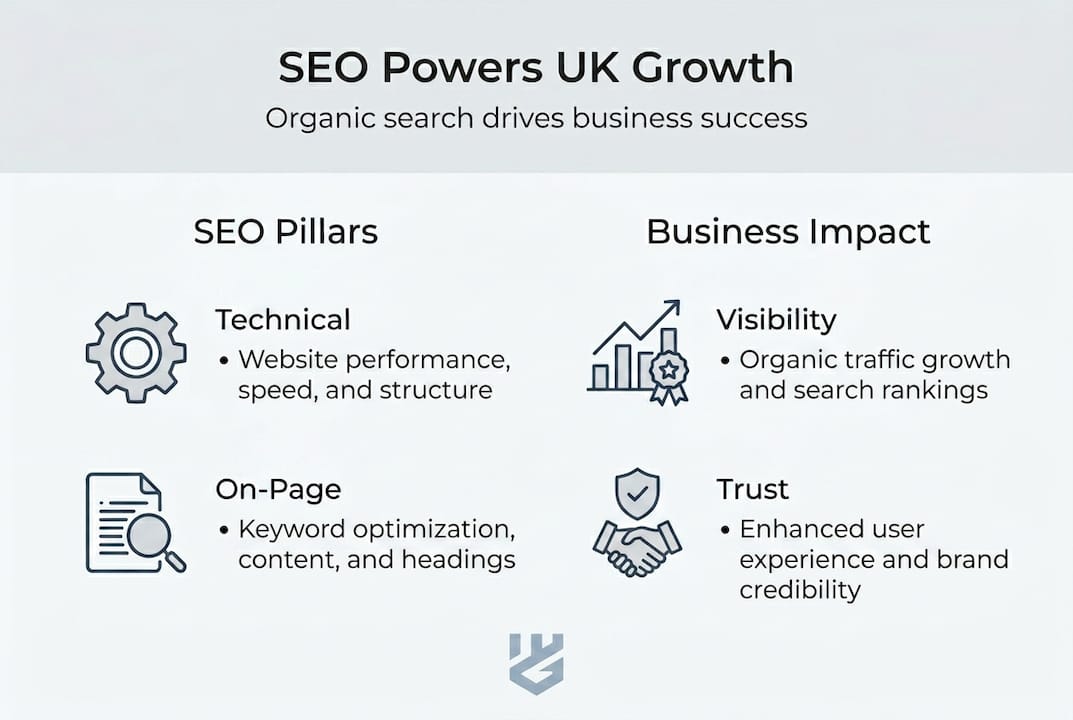
SEO for business growth does not just deliver traffic. It delivers the right traffic. Someone searching “accountant for small business Manchester” is not browsing casually. They have a need, and they are ready to act. Appearing in front of that person at that moment is worth far more than a thousand random impressions on a display ad.
The business impacts of strong SEO are wide-ranging:
- Increased lead generation from people actively searching for your products or services
- Brand authority built through consistent visibility across relevant search terms
- Cost-effective marketing compared to pay-per-click advertising, which stops the moment your budget runs dry
- Trust signals for potential customers who associate top search positions with credibility
- Compounding returns where today’s content and links continue to generate traffic for years
That last point deserves more attention. Paid adverts are like renting a billboard. When you stop paying, the billboard goes blank. Organic search traffic from well-executed SEO compounds over time, much like interest in a savings account. The effort you put in today builds on itself month after month.
“SEO is not just for higher rankings—it’s foundational to business growth, building visibility, credibility, and consistent traffic.” This view, supported by Google’s own guidance, confirms that businesses treating SEO as a long-term investment consistently outperform those chasing short-term tactics.
The data backs this up. Studies consistently show that organic search drives more than 50% of all trackable website traffic across industries. For UK SMEs competing without the advertising budgets of large corporations, that figure is not just encouraging. It is a lifeline.
There is also the question of quality versus volume. Chasing high search volume keywords without considering whether your business can genuinely serve that audience is a shortcut to wasted effort. The businesses transforming themselves with SEO focus on relevance first, volume second. They target the search terms that match their actual customer base, and they build content and authority around those terms systematically.
Core principles: What makes SEO drive real business outcomes?
Understanding why SEO matters sets the stage for knowing what makes it tick. The next step is understanding the key levers for practical business impact.
SEO is not one thing. It is a collection of disciplines that work together. Focusing on only one element while neglecting the others is like tuning the engine of a car but forgetting to put air in the tyres. Everything must work in concert.
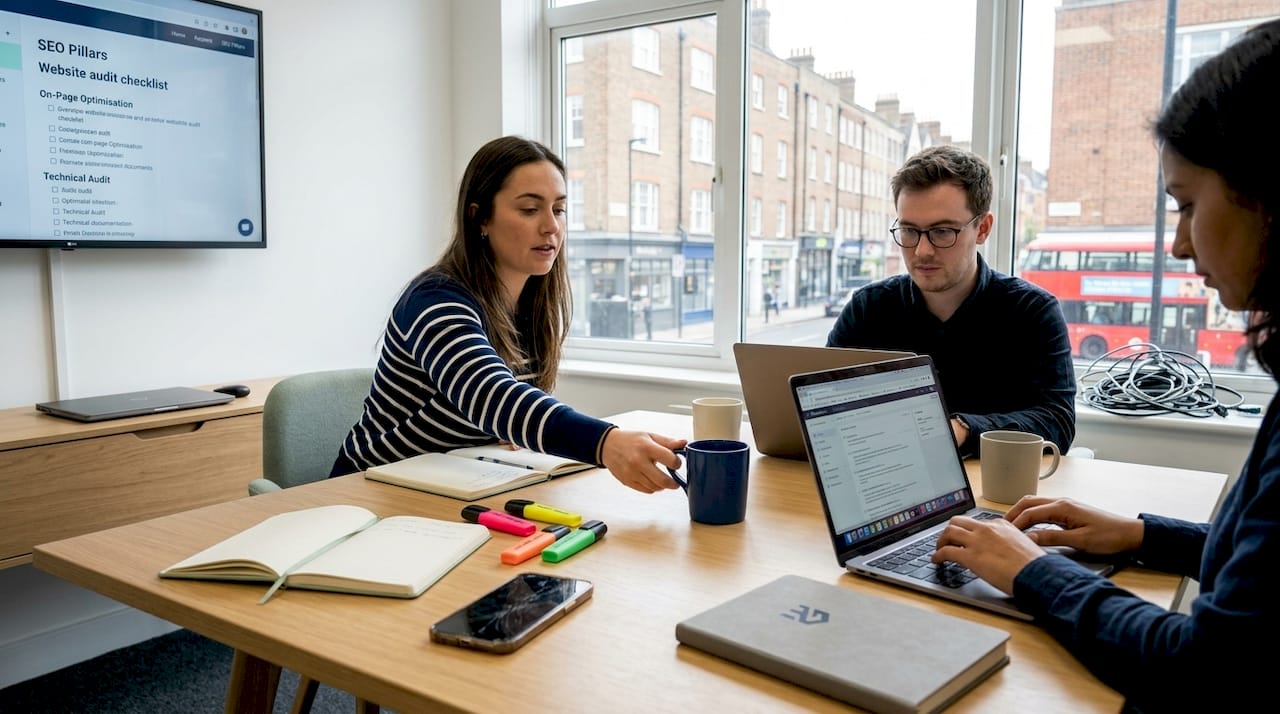
Here is how the core pillars break down:
| SEO pillar | What it does | Business impact |
|---|---|---|
| Technical audit | Identifies crawl errors, site speed issues, and schema problems | Ensures your site can be found and indexed properly |
| On-page optimisation | Aligns page content, titles, and headings with search intent | Attracts the right visitors at the right stage of the buying journey |
| Content strategy | Builds topical authority through valuable, relevant content | Establishes trust and keeps visitors engaged longer |
| Link building | Earns backlinks from credible, relevant sites | Signals authority to Google, boosting rankings and domain strength |
Technical SEO audits are where most campaigns should start. Before you write a single word of new content or reach out for a single link, you need to know whether Google can actually crawl and understand your website. A site that loads slowly, has broken links, or lacks proper structured data is already working against itself. Fixing these issues is not glamorous, but it is foundational.
On-page SEO techniques go beyond stuffing keywords into headings. They involve understanding what your customers are actually trying to accomplish when they search, and then crafting pages that answer those needs clearly and helpfully. A local solicitor, for example, would not just target “solicitor UK.” They would build pages around specific queries like “conveyancing solicitor Birmingham” or “employment law advice for small business.” Precision matters enormously here.
Content strategy is how you build sustained authority in your niche. Rather than publishing random blog posts, the most effective approach is building topic clusters, a main pillar page covering a broad subject, supported by in-depth articles on related subtopics. This structure helps Google understand your expertise and helps customers navigate your website naturally.
Link building authority remains one of the most powerful signals in Google’s algorithm. When a credible industry publication or a respected local organisation links to your website, it is essentially a vote of confidence. The quality of those votes matters far more than the quantity. Ten links from highly relevant, trusted sources outweigh a hundred links from low-quality directories.
Pro Tip: Do not treat these four pillars as separate projects with separate budgets. The compounding effect comes when they reinforce each other. A technically sound website, filled with expert content, earning quality backlinks, is almost impossible to knock off its position once established. As Google’s documentation confirms, combining technical audits, on-page SEO, content strategy, and link building is what delivers sustainable, lasting business value.
Modern challenges: AI disruption and the fundamentals that stay the same
With the essentials of SEO defined, it’s crucial to consider how new developments, like AI, are changing how businesses use SEO for growth.
Artificial intelligence has changed the search landscape in ways that genuinely matter for business owners. Google’s AI-generated summaries now appear at the top of many results, sometimes answering a user’s question before they even click on a website. For certain query types, this has reduced click-through rates. It is a real shift, and pretending otherwise would be dishonest.
But here is what that change does not mean. It does not mean SEO is dead. It does not mean organic search is irrelevant. What it means is that the stakes for quality have risen significantly.
Website optimisation strategies must now account for a more discerning search environment. Google’s AI draws on content it judges to be authoritative, accurate, and genuinely useful. Thin, keyword-stuffed pages are not just less effective. They are actively penalised in how AI features present information.
“While AI changes some search dynamics, including fewer clicks and a greater focus on citation, quality content and technical rigour remain vital.” This is a crucial point for UK SMEs to absorb: the businesses that were building genuine authority before AI arrived are the ones benefiting most from it now.
What remains non-negotiable in the post-AI search era:
- Reliable site indexing: If Google cannot crawl your pages properly, you will not be cited or ranked
- User-focused content: Content written to genuinely help readers, not just to rank, is what AI tools surface
- Genuine backlinks: Links from real, relevant sources still signal authority to both traditional and AI-powered ranking systems
- Technical soundness: Fast, secure, mobile-friendly websites remain the baseline expectation
- Clear search intent alignment: Content that directly addresses what a searcher needs converts better and ranks more consistently
The businesses struggling with the AI shift are those that were already cutting corners. They were buying cheap backlinks, producing generic content, and ignoring technical SEO essentials. The new environment has simply made those shortcuts more costly.
Pro Tip: Run regular audits checking both your site’s crawlability and your content’s genuine helpfulness. Ask yourself honestly: if a potential customer read this page, would they leave with something genuinely useful? If the answer is uncertain, that page needs work before the next algorithm update arrives.
Putting SEO into practice: A roadmap for UK SMEs
Having covered both the shifting landscape and enduring basics, here’s how small business owners can put the role of SEO into action today.
Knowing the theory is one thing. Knowing where to start on a Monday morning is another. Here is a straightforward roadmap that owner-managers at small and medium businesses can actually follow.
-
Audit your current website using a tool like Screaming Frog or Google Search Console. Identify broken pages, slow-loading content, and missing metadata. Fix critical issues before moving on to anything else.
-
Research search intent for your key services. Use Google’s autocomplete and “People Also Ask” sections to understand exactly what your customers are searching for. Build a keyword list that reflects real buyer intent, not just broad industry terms.
-
Optimise your most important pages first. Your homepage, service pages, and contact page are where most conversions happen. Ensure these pages have clear, intent-matched titles, helpful content, and fast load times.
-
Build content clusters around your core topics. Choose three or four themes that matter most to your business. Create a detailed pillar page for each, then support it with shorter articles exploring related questions your customers ask.
-
Earn quality backlinks through genuine relationships. Reach out to local business associations, industry publications, and complementary service providers. Guest articles, local sponsorships, and expert commentary in trade press are all legitimate routes.
-
Track the right metrics. Rankings matter, but they are not the only measure of success. Track organic traffic, enquiry form completions, phone calls, and ultimately revenue attributed to organic search. These numbers tell you whether SEO is actually growing your business.
| Approach | Time to results | Cost | Risk level |
|---|---|---|---|
| DIY SEO | 9-18 months | Low financial cost, high time cost | High (without expertise) |
| Hiring a consultant | 4-8 months | Moderate ongoing investment | Low (with the right partner) |
| Agency model | 4-8 months | Higher ongoing investment | Medium (varies by agency quality) |
The website optimisation steps that deliver the fastest results are almost always the technical fixes. Many UK SME websites have fundamental indexing or speed issues that, once resolved, produce noticeable improvements within weeks. After that, the content and link-building work layers on top.
If you are considering whether to hire professional help, the honest answer is that SEO website design and technical work done incorrectly can set a business back significantly. Choosing a consultant with a proven track record and transparent reporting is almost always more efficient than learning through trial and error.
Pro Tip: Set a specific growth target for your SEO programme before you begin. For example, “increase organic enquiries by 30% over 12 months” is measurable and connects SEO directly to business outcomes. Without a clear goal, it is easy to lose focus and drift towards vanity metrics like rankings that do not directly translate to revenue.
The uncomfortable truth most business owners miss about SEO
Here is something that most SEO articles will not say directly: the vast majority of businesses chasing top rankings are not growing their businesses. They are growing their traffic numbers, and those are not the same thing.
The mistake is focusing on volume without substance. Attracting ten thousand monthly visitors who have no real interest in your services is worth nothing compared to five hundred visitors who are precisely matched to what you offer. Over-reliance on traffic volume without content quality does not just waste money. It risks penalties and erodes the trust your brand needs to convert visitors into customers.
Real, lasting SEO growth is almost invisible when it is working properly. It is woven into the fabric of how your website communicates, how your content serves your audience, and how your reputation is perceived across the web. It is not a monthly report with arrows pointing upward. It is a steadily growing pipeline of qualified enquiries.
The businesses we see getting the best results treat using an SEO consultant as a partnership, not a purchase. They invest in relevance, trust, and delivering genuine value to their audience month after month. That approach compounds in ways that no short-term tactic ever will. Sustainable SEO wins, every time, without exception.
Take the next step: Power your growth with proven SEO services
If this article has shifted how you think about SEO, you are already ahead of most business owners. The next step is putting that understanding into action with the right support behind you.
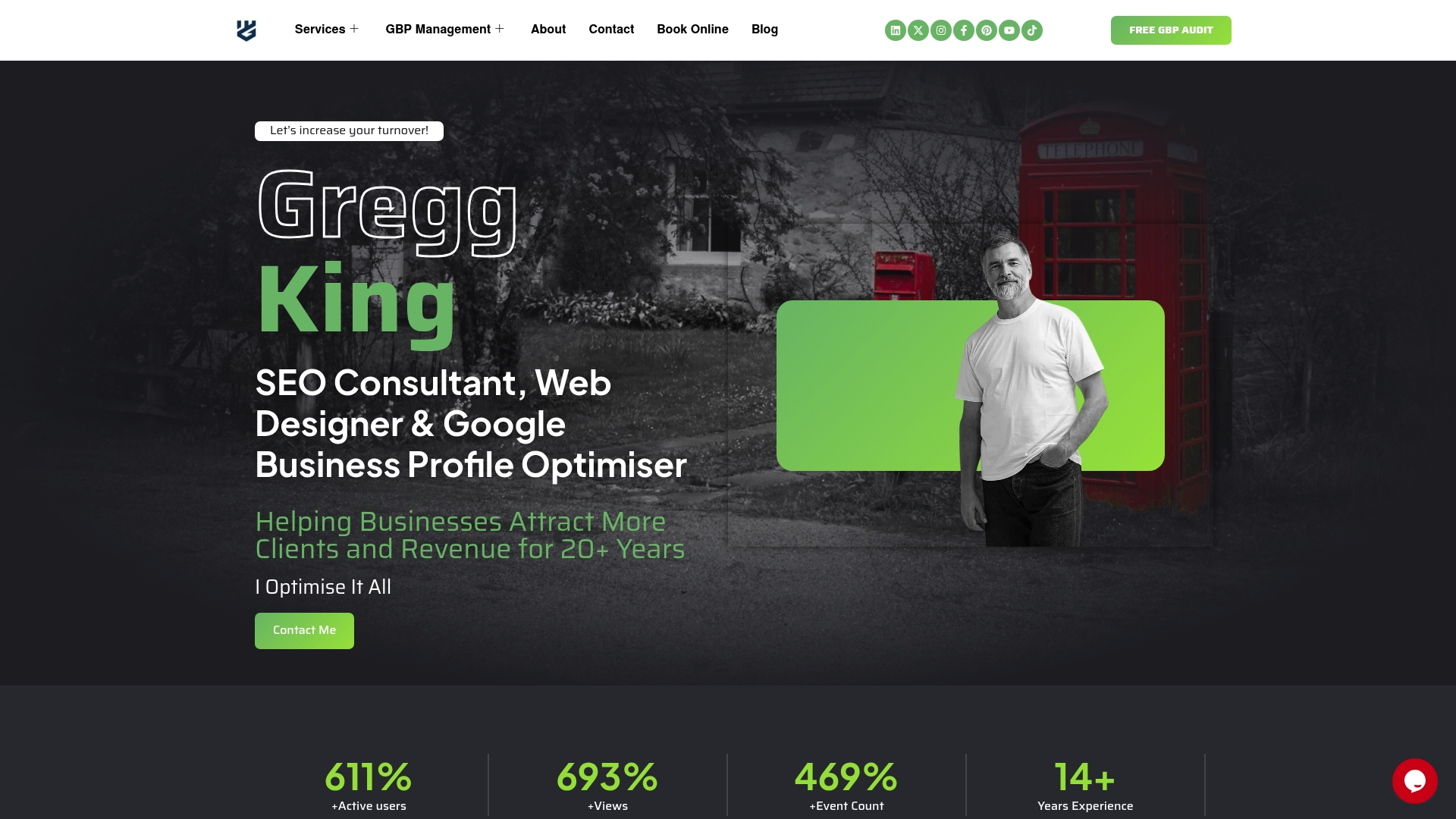
At Gregg King, we bring over 20 years of hands-on experience to every client we work with. Whether you need professional SEO and website design built around your specific business goals, or want to understand the full range of SEO consultant benefits before committing, we are here to help. We offer a free initial consultation so you can see exactly how a tailored SEO strategy could accelerate your growth. No pressure, no jargon. Just clear, practical advice from someone who genuinely knows how to move the needle for UK businesses.
Frequently asked questions
How long does it take to see SEO results for a small UK business?
Most SMEs notice meaningful improvements within four to six months, with results building steadily as the strategy matures and search engines recognise growing authority.
Can I do SEO myself or should I hire a consultant?
DIY SEO is possible with the right tools and learning, but even small technical errors can have a significant negative impact. As Google’s technical guidelines make clear, getting crawlability, speed, and schema right from the start is essential, and a consultant makes that far less risky.
Does SEO still work with AI now dominating search?
Absolutely. The shift in search dynamics brought about by AI has raised the bar for quality, but businesses with strong, trustworthy SEO are better positioned in AI-powered results than ever before.
What is the most important SEO step for growth-focused businesses?
Creating genuinely valuable content that answers real customer questions is the single biggest driver of sustainable growth. Technical foundations must be solid first, but content is what builds lasting authority and converts visitors into paying customers.