TL;DR:
- Most web pages receive no organic traffic due to unfocused SEO efforts.
- Effective SEO combines content quality, technical health, authority building, and user experience.
- SEO is a long-term asset that requires steady investment and continuous refinement for sustained growth.
Over 96% of web pages receive zero traffic from organic search, which means most business websites are effectively invisible to potential customers. Simply launching a website is no longer enough. Without a clear SEO strategy, you are essentially opening a shop on a street nobody walks down. Search engine optimisation gives your business the visibility it needs to attract the right customers, generate leads, and grow revenue. This guide breaks down what SEO actually means in 2026, the real benefits it delivers for UK small and medium-sized businesses, the common pitfalls to avoid, and the practical steps to build a strategy that compounds in value over time.
Table of Contents
- Understanding SEO: more than just keywords
- The key benefits of investing in SEO for your business
- Common challenges and pitfalls: why most pages fail
- How to get started: strategies for sustainable SEO success
- A fresh perspective: why SEO is a long-term asset, not a quick fix
- Ready to accelerate your SEO growth?
- Frequently asked questions
Key Takeaways
| Point | Details |
|---|---|
| SEO drives growth | Consistent SEO investment increases your website visibility, traffic and revenue over time. |
| Quality over quantity | Focusing on valuable, well-optimised content yields better results than large volumes of low-quality pages. |
| Long-term sustainability | SEO is not a quick win but a sustainable, compounding asset for your business. |
| Expert help matters | Professional SEO expertise can help you avoid common pitfalls and speed up your progress. |
Understanding SEO: more than just keywords
SEO, or search engine optimisation, is the strategic process of improving your website so it appears prominently in search engine results when potential customers look for products or services like yours. Many business owners still think SEO means stuffing a webpage with keywords. That mindset belongs to 2005, not today.
Modern SEO is built on four interconnected pillars:
- On-page SEO: The quality, relevance, and structure of the content on your pages, including headings, metadata, and keyword intent
- Technical SEO: Site speed, mobile-friendliness, crawlability, and structured data that help search engines understand and index your site
- Off-page SEO: The authority your website builds through backlinks, mentions, and your overall reputation across the web
- User experience (UX): How easy and enjoyable your website is to use, which Google now weighs heavily in rankings
Think of SEO like maintaining a healthy business. You cannot focus on one department and ignore the others. A slick-looking website with poor technical foundations will still rank poorly. Great content with no authority behind it will struggle to compete.
“Quality over quantity is what separates the pages that earn traffic from the overwhelming majority that receive none at all.”
This is a critical insight for UK business owners. The data shows most pages get no traffic regardless of how much content exists on the internet, which means strategic, high-quality effort is the only approach that works. Producing twenty average blog posts will not outperform one genuinely useful, well-optimised page that answers a real customer question.
Understanding whether SEO services are worth it often comes down to this single realisation: SEO is not a content production conveyor belt. It is a strategic discipline that connects your business directly to people who are actively searching for what you offer. When done properly, as explored in how SEO transforms businesses across industries, the results are tangible and lasting.
The key benefits of investing in SEO for your business
Having established what SEO is, let’s explore the specific benefits your UK business can expect from targeted investment.
| Benefit | What it means for your business |
|---|---|
| Increased visibility | Your website appears when potential customers search for your services |
| Cost-effective growth | Organic traffic costs nothing per click once rankings are achieved |
| Trust and credibility | High organic rankings signal authority and reliability to searchers |
| Long-term ROI | Results compound over time unlike paid advertising that stops immediately |
| Competitive advantage | Outranking competitors means capturing their potential customers |
Traffic and visibility are the most obvious wins. When your business appears on page one of Google for relevant searches, you gain access to customers who are already looking for exactly what you offer. These are warm leads, not cold outreach.

The cost-effectiveness argument for SEO is genuinely compelling. Pay-per-click advertising charges you every time someone clicks. Once you stop paying, the traffic stops. SEO builds an asset. The effort invested today continues delivering results months and years later. Businesses see improved leads and long-term ROI from SEO investment in ways that paid advertising simply cannot replicate at scale.
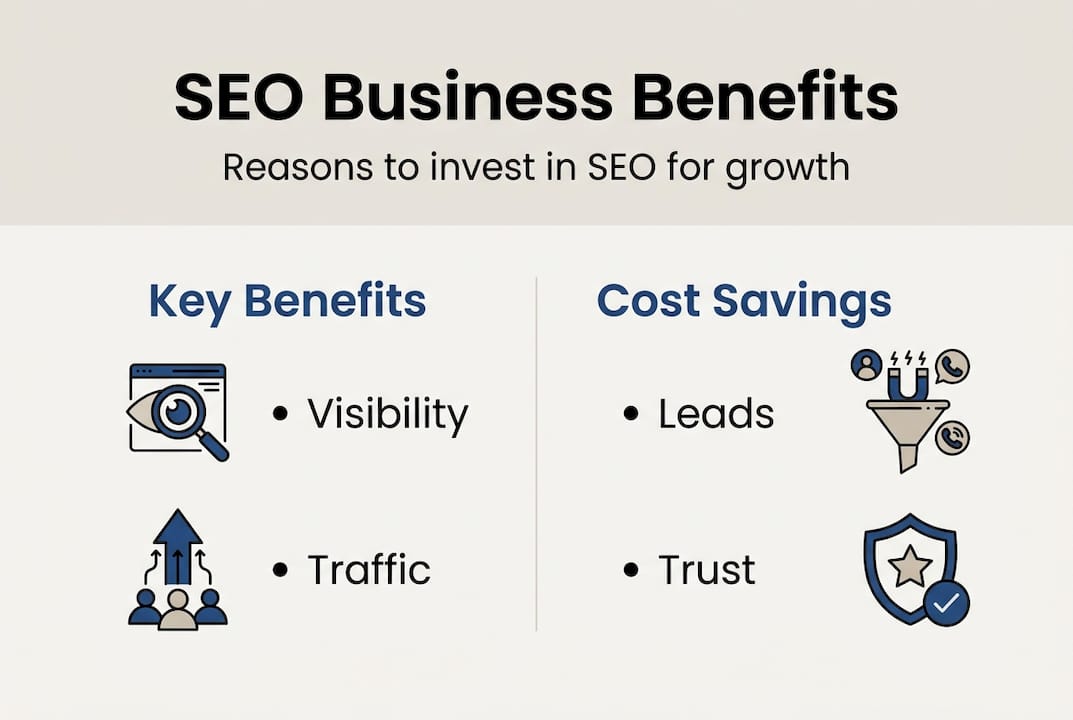
Trust is another underestimated factor. Research consistently shows that users trust organic results more than paid adverts. Appearing organically signals that Google has validated your content as genuinely relevant and authoritative.
Key benefits at a glance:
- Sustained organic traffic without ongoing ad spend
- Higher quality leads from people actively searching
- Improved brand credibility and recognition in your sector
- Greater local visibility for searches near your area
- Protection against over-reliance on paid channels
Pro Tip: Combining SEO with Google Business Profile optimisation and technical improvements creates a powerful multiplier effect, particularly for local searches where customers are ready to buy. Explore the consultancy advantages available to UK small businesses to understand how a joined-up approach works in practice.
Common challenges and pitfalls: why most pages fail
With the benefits clear, it is equally important to understand why some SEO efforts fall flat.
The uncomfortable truth is that 96.55% of pages never receive a single organic visit. That is not because SEO is broken. It is because most SEO efforts are unfocused, superficial, or technically flawed.
Common SEO mistakes compared:
| Weak approach | Stronger alternative |
|---|---|
| Publishing content in bulk with no strategy | Fewer, deeply researched, intent-focused pages |
| Ignoring technical issues like slow load times | Regular technical audits and structured data implementation |
| Chasing backlinks from low-quality sources | Building genuine authority through relevant, earned links |
| Writing for keywords without addressing user intent | Answering real questions your customers are actually asking |
| Set-and-forget SEO with no ongoing refinement | Continuous monitoring and improvement based on real data |
Here are the most damaging mistakes UK SMEs make and how to avoid them:
- Prioritising quantity over quality. Publishing more pages than your competitors does not mean outranking them. Depth, relevance, and authority matter far more.
- Ignoring technical foundations. Slow page speed, broken links, and missing structured data all suppress rankings. Google cannot rank what it cannot properly read and understand.
- Neglecting local SEO. Many UK businesses overlook the power of local search optimisation, missing out on high-intent customers in their own area.
- Expecting overnight results. SEO requires patience. Businesses that abandon their strategy after two months never see the compounding returns that come later.
- Overlooking AI Overviews. Google’s AI-generated answers now appear above traditional results for some informational queries, which affects traffic on certain search types. Focusing on commercial and local queries where AI Overviews are less prevalent protects your strategy.
Pro Tip: Getting support from SEO consultancy specialists early on helps you avoid the costly trial-and-error phase. Understanding why use SEO consulting is often the turning point for businesses that have tried SEO and found it frustrating.
How to get started: strategies for sustainable SEO success
To ensure you realise the full value of your SEO investment, here are practical steps you can implement now.
- Commission an SEO audit. Before doing anything else, understand where you currently stand. An audit reveals technical issues, content gaps, and off-page weaknesses that need addressing. It gives you a baseline to measure progress against.
- Fix technical foundations first. Site speed, mobile responsiveness, crawl errors, and XML sitemaps need to be in good shape before any content or link-building work will have its full effect.
- Implement structured data. Structured data (also called schema markup) helps search engines understand your content precisely. It also improves entity authority for AI-driven search features like rich results and knowledge panels, which are increasingly important in 2026.
- Create content around genuine customer intent. Research what your ideal customers are actually searching for. Answer their real questions with depth and accuracy rather than targeting keywords mechanically.
- Build local relevance. Claim and fully optimise your Google Business Profile. Ensure your name, address, and phone number are consistent across all online directories. Encourage genuine customer reviews.
- Integrate SEO into web design. A well-structured website built with SEO in mind will outperform a retrofitted one. When design and SEO work together from the start, every page earns its place.
- Set metrics and track progress. Use tools like Google Search Console and Google Analytics to monitor rankings, traffic, and conversions. Review data monthly and refine your approach accordingly.
Pro Tip: SEO works best when combined with complementary channels. Pairing your SEO with digital marketing strategies including social media and Google Business Profile management creates a cohesive online presence that reinforces your visibility from multiple angles. If you are unsure where to start, working with an SEO consultant can save considerable time and money.
A fresh perspective: why SEO is a long-term asset, not a quick fix
To frame your SEO journey with the right expectations, here is an angle that is often overlooked.
Most business owners who are frustrated with SEO have approached it like a light switch. They invest for a few months, see limited movement, and conclude it does not work. But SEO behaves more like planting a tree than flipping a switch. The early months are about building roots, not visible growth.
The businesses we see succeed with SEO are not the ones chasing the latest algorithm shortcut. They are the ones that commit to steady improvement, fix what is broken, create genuinely useful content, and let the power of SEO accumulate over time. Six months in, they see movement. Twelve months in, they see momentum. Two years in, they have a digital asset that generates leads around the clock.
Short-term hacks do not just fail. They often cause harm, triggering penalties that take months to recover from. The mindset shift from “quick win” to “long-term asset” is genuinely the most important step any UK business owner can take before investing in SEO.
Ready to accelerate your SEO growth?
If you have read this far, you already understand that SEO is not optional for a business that wants to grow online. It is the foundation that everything else is built upon.
At Gregg King, we offer tailored SEO and website design services specifically for UK small and medium-sized businesses. Whether you need a full SEO strategy, a technically optimised website, or expert Google Business Profile optimisation to capture local search traffic, we bring over 20 years of hands-on experience to every project. Discover the full range of SEO consultant benefits and book a free consultation today to find out exactly what is holding your website back and how to fix it.
Frequently asked questions
How long does it take to see SEO results?
Noticeable improvements typically appear within 3 to 6 months, but the biggest gains come after 12 months or more as your site builds authority. SEO is a long-term strategy with compounding returns that grow steadily over time.
Is SEO still relevant in 2026 with AI search changes?
Absolutely. While AI Overviews affect some informational queries, commercial and local search results remain heavily dependent on traditional SEO signals, making structured data and authoritative content more important than ever.
Do I need professional help or can I DIY my SEO?
Basic SEO tasks can be managed in-house, but for competitive markets, expert guidance avoids pitfalls and accelerates results significantly, often saving money that would otherwise be wasted on ineffective tactics.
What is the difference between organic and paid search?
Organic search is earned through SEO and builds lasting credibility over time, while paid search delivers immediate visibility that disappears the moment your budget runs out. Organic rankings also tend to attract higher trust from searchers than paid adverts.