
Your website might look perfectly fine on the surface, yet quietly haemorrhage traffic every single day. Silent SEO errors, from broken internal links to misconfigured canonical tags, are invisible to the naked eye but devastatingly visible to Google. In fact, only 33% of sites pass basic SEO checks, meaning the majority of UK business websites carry hidden issues that suppress rankings. This guide gives you a practical, expert-approved checklist to audit your site thoroughly, fix what’s broken, and build the kind of search visibility that brings in consistent, qualified traffic.
Table of Contents
- Why a comprehensive SEO audit matters for UK businesses
- Tools and prerequisites: What you need for an effective SEO audit
- The complete SEO audit checklist for UK businesses
- Verifying fixes and avoiding common mistakes
- Get expert help and maximise your SEO results
- Frequently asked questions
Key Takeaways
| Point | Details |
|---|---|
| Audit covers 8 categories | Effective SEO audits for UK SMEs include technical, content, links, local, schema, AI and compliance checks. |
| Prioritise by impact | Use expert scoring to fix the biggest issues first, focusing on Core Web Vitals and local optimisation. |
| Avoid silent killers | Routine audits uncover hidden errors like toxic backlinks or slow pages that harm search visibility. |
| Include UK compliance | Always check GDPR, cookies, and legal page requirements for full regulatory compliance. |
| Support is available | Professional SEO consultants can help with advanced audits, local optimisation, and actionable advice. |
Why a comprehensive SEO audit matters for UK businesses
Most UK small and medium-sized enterprises (SMEs) are familiar with the basics: write good content, get some backlinks, and make sure your site loads. But that surface-level thinking leaves enormous ranking potential on the table. A proper audit goes far deeper, exposing the technical faults and content gaps that quietly cost you customers.
The business case is straightforward. When you fix what an audit uncovers, you increase your chances of ranking for competitive non-branded and local search terms. These are the searches where buyers are actively looking for what you sell, not just browsing. Our own SEO success stories show how UK SMEs have moved from page three obscurity to page one prominence simply by acting on audit findings.
Some of the most damaging issues are the ones you’d never spot without dedicated tools:
- Slow page speed that causes visitors to leave before your page even loads
- Toxic backlinks from spammy sites that erode your domain authority
- Duplicate content that confuses Google about which page to rank
- Missing or broken structured data that prevents rich results in search
- GDPR and cookie compliance gaps that can attract regulatory attention
UK businesses also face a compliance dimension that many international SEO guides ignore. GDPR, cookie consent banners, and data capture forms all fall within the scope of a thorough audit. As Semrush notes, SEO audits for UK SMBs should cover 8 core categories, and compliance is firmly among them.
“A regular audit is not a one-off fix. It is an ongoing process that protects your rankings, keeps you compliant, and ensures your site evolves alongside Google’s algorithm.”
Quarterly audits are the gold standard. They catch regressions early, keep your content fresh, and ensure you are never blindsided by a Google core update.
Tools and prerequisites: What you need for an effective SEO audit
Before you run a single crawl, you need the right tools and a clear picture of your site’s current state. Jumping in without preparation wastes time and produces incomplete results.

Here is a comparison of the core tools every UK business should have in their audit toolkit:
| Tool | Primary use | Cost |
|---|---|---|
| Google Search Console | Index coverage, manual actions, Core Web Vitals | Free |
| Screaming Frog | Full site crawl, broken links, redirects | Free up to 500 URLs |
| Ahrefs or Semrush | Backlink analysis, keyword gaps, site health | Paid (trials available) |
| Google PageSpeed Insights | Page load performance, CWV scores | Free |
| Google Business Profile | Local SEO, citation management | Free |
Beyond the tools themselves, your pre-audit preparation matters enormously. Before you begin:
- Back up your website so you can reverse any accidental changes
- List your ten most important landing pages by revenue or traffic
- Gather login credentials for Google Search Console, Analytics, and your GBP
- Locate your GDPR documentation and cookie consent configuration
- Note any recent site changes, migrations, or plugin updates
For UK businesses specifically, auditing your GBP across 120+ directories and localising your content with UK-specific credentials is essential. Avoid URL parameters for language or region targeting, as these create crawl inefficiencies. Our guide on technical SEO tools covers the setup process in more detail.
Pro Tip: Set up a dedicated spreadsheet before you start. Log every issue you find, the tool that flagged it, its priority level, and the date you fixed it. This single habit will save you hours on every future audit.
The complete SEO audit checklist for UK businesses
A structured checklist prevents you from missing critical issues. Work through each category in order, as technical problems often mask on-page and content issues underneath.
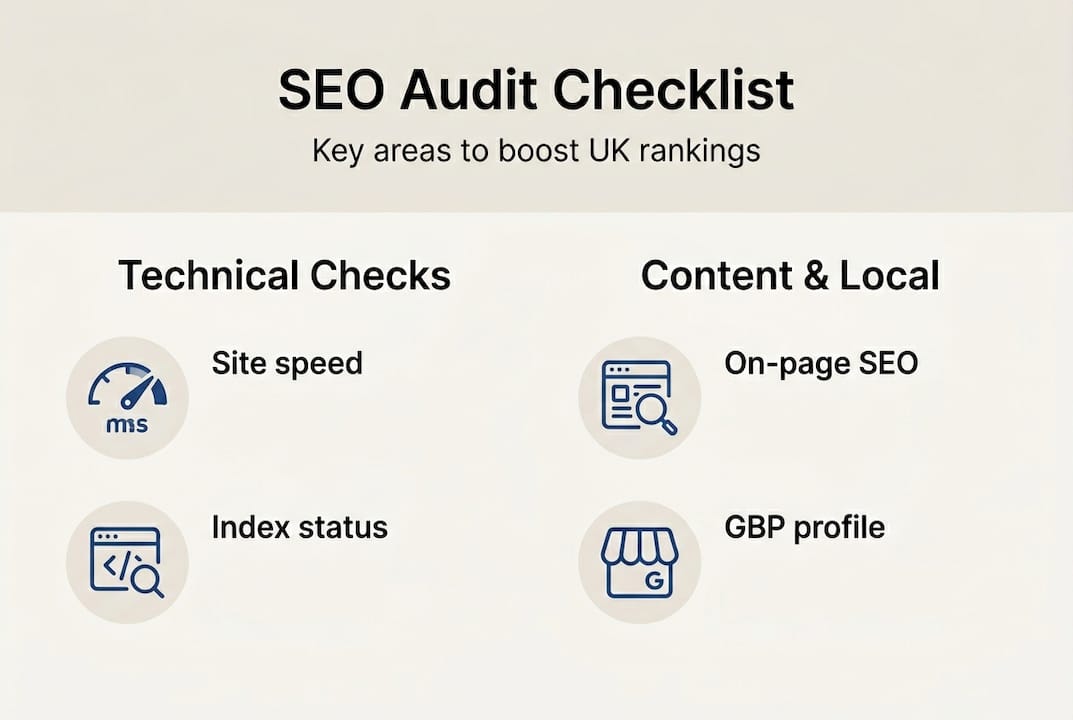
SEO audits for UK SMBs should cover 8 core categories: Technical SEO, On-Page SEO, Content Quality, Backlinks, Local SEO, Schema, AI readiness, and UK compliance. Here is how to tackle each one:
- Technical SEO — Crawl your site with Screaming Frog. Fix broken links (4xx errors), resolve redirect chains, and confirm your XML sitemap is submitted to Google Search Console. Check for duplicate pages caused by trailing slashes or URL parameters.
- On-page SEO — Audit every key page for a unique title tag (50 to 60 characters), a compelling meta description, and a single H1. Ensure your target keyword appears naturally in the first 100 words.
- Content quality — Identify thin pages (under 300 words with no clear purpose), outdated statistics, and content that no longer matches search intent. Freshness is a ranking signal Google takes seriously.
- Backlinks — Use Ahrefs or Semrush to identify toxic or irrelevant backlinks. Disavow where necessary. Look for broken backlinks pointing to your site and redirect them to live pages.
- Local SEO — Verify your GBP is fully completed, including opening hours, service areas, and recent photos. Check your local SEO checklist to ensure NAP (name, address, phone) consistency across all directories.
- Schema markup — Confirm you have LocalBusiness, FAQ, and Review schema where appropriate. Structured data helps Google understand your content and can unlock rich results.
- AI and GEO readiness — Prioritise by impact (P0 to P3) and ensure your content includes question-based headings and direct answers. AI-powered search features favour content that is clearly structured and authoritative.
- UK compliance — Check your cookie consent banner fires correctly, your privacy policy is linked in the footer, and all data capture forms include the required consent language.
For a deeper walkthrough of each step, our guide on SEO audit steps covers the technical detail behind each category.
| Priority level | Issue type | Example |
|---|---|---|
| P0 (critical) | Site not indexable, manual penalty | Noindex on homepage |
| P1 (high) | Core Web Vitals failure, broken checkout | LCP over 4 seconds |
| P2 (medium) | Missing schema, thin content | FAQ page with no markup |
| P3 (minor) | Image alt text, minor meta tweaks | Missing alt on blog images |
Pro Tip: Always include a manual review of your top five pages alongside your automated crawl. Tools catch technical errors brilliantly, but only a human can judge whether your content genuinely answers the reader’s question with authority and relevance.
Verifying fixes and avoiding common mistakes
Running the audit is only half the job. Confirming that your fixes have actually worked is where many UK businesses fall short. They implement changes and assume the problem is solved, without ever checking the data.
Here is how to verify your improvements properly:
- Compare before and after data in Google Search Console. Look at impressions, clicks, and average position for your target pages over a 28-day window.
- Re-crawl your site with Screaming Frog two to four weeks after making changes to confirm errors are resolved.
- Monitor Core Web Vitals in PageSpeed Insights. A P1 fix should show measurable improvement within a few weeks of deployment.
- Track local rankings using a rank tracker set to your specific UK location, not just national averages.
The most common mistakes UK SMEs make during audits are surprisingly consistent. Overlooking technical errors because they are not immediately visible. Neglecting GDPR compliance because it feels like a legal issue rather than an SEO one. Failing to localise content for UK audiences, using American spellings or generic location references that do not resonate with local searchers.
“Document every change you make during an audit. Without a clear record, you cannot isolate what caused an improvement or a drop.”
As expert guidance confirms, prioritising by impact (P0 to P3) and ensuring GEO readiness through structured data and question-based content are the two habits that separate effective audits from superficial ones. Set a calendar reminder for your next audit the moment you finish this one. Our audit best practices guide gives you a repeatable framework to make this process faster every time.
Pro Tip: Document every change you make, including the date, the specific fix, and the tool you used to verify it. This log becomes invaluable when you need to troubleshoot a ranking drop or brief a new team member.
Get expert help and maximise your SEO results
Working through a full SEO audit on your own is absolutely achievable, and this checklist gives you a solid foundation. But there are moments when professional eyes catch what even diligent business owners miss.
At Gregg King SEO, we offer hands-on support for UK businesses that want to move beyond the basics. Whether you need GBP optimisation help to dominate local search results, or you want to explore the benefits of working with an SEO consultant who understands the UK market inside out, we can build a strategy around your specific goals. For businesses ready to take rankings seriously, our SEO success tips resource is a strong next step. Get in touch for a free consultation and find out exactly where your site stands.
Frequently asked questions
How often should UK businesses run an SEO audit?
A quarterly audit is ideal to stay ahead of algorithm changes and catch silent SEO issues before they compound into serious ranking drops.
What GDPR and cookie checks are required during an SEO audit for UK sites?
You must verify a visible cookie consent banner, a linked privacy policy in the footer, and compliant data capture forms. UK compliance is a core audit category, not an optional extra.
What is the most common mistake UK SMEs make in SEO audits?
Many businesses miss technical issues like unoptimised site speed and fail to audit GBP across directories thoroughly, leaving significant local ranking potential untapped.
Why is Google Business Profile so important in a UK SEO audit?
Auditing and optimising your GBP directly improves your visibility in local map results and near-me searches. Local SEO and GBP citations are a core category in any thorough UK audit.
Recommended
- How to Run a 2026 SEO Audit: Step-by-step to Uncover Growth for UK Businesses – Gregg King SEO
- How to Run a 2026 SEO Audit: The UK Playbook for Uncovering Hidden Growth – Gregg King SEO
- Advanced Technical SEO Tactics to Boost Your Google Business Profile Rankings (UK Guide) – Gregg King SEO
- 12 Local SEO issues stopping UK businesses appearing for high‑intent searches (and how to fix them) – Gregg King SEO