
TL;DR:
- Accurate, consistent business listings across platforms are essential for local search success.
- Google Business Profile is crucial but must be supported by a strong citation ecosystem.
- Ongoing management and NAP consistency significantly boost local rankings and customer trust.
Nearly 78% of local mobile searches result in an in-store visit, yet thousands of UK businesses are losing those customers before they even arrive. Why? Because their listings are missing, outdated, or riddled with errors. There’s a widespread belief that setting up a Google Business Profile (GBP) is enough to secure local search visibility. It isn’t. GBP is essential, yes, but it’s one part of a broader ecosystem of citations, directories, and consistent data signals that collectively tell Google your business is real, relevant, and trustworthy. This guide breaks down exactly how business listings work and what you should do about them.
Table of Contents
- What are business listings and why do they power local SEO?
- How Google Business Profile and core UK listings drive local visibility
- Why NAP consistency and citation quality are crucial for SEO success
- Practical strategies: Audit, build and maintain business listings for UK SMBs
- The real value: Quality over quantity and ongoing listing management
- Take your local SEO further with expert support
- Frequently asked questions
Key Takeaways
| Point | Details |
|---|---|
| GBP is vital | A fully optimised Google Business Profile drives the most local SEO impact for UK businesses. |
| Consistency builds trust | Exact NAP details and citation accuracy are essential for search rankings and customer confidence. |
| Quality outweighs quantity | A focused set of high-authority business listings outperforms chasing hundreds of low-value citations. |
| Routine maintenance is key | Regular audits and updates keep your business listings working for you and prevent costly errors. |
What are business listings and why do they power local SEO?
A business listing is any online reference to your business that includes your name, address, and phone number. These appear across platforms like Google Business Profile, Yell.com, ThomsonLocal, Bing Places, Apple Maps, FreeIndex, and hundreds of other directories. Each listing acts as a vote of confidence, signalling to search engines that your business exists and operates where it claims to.
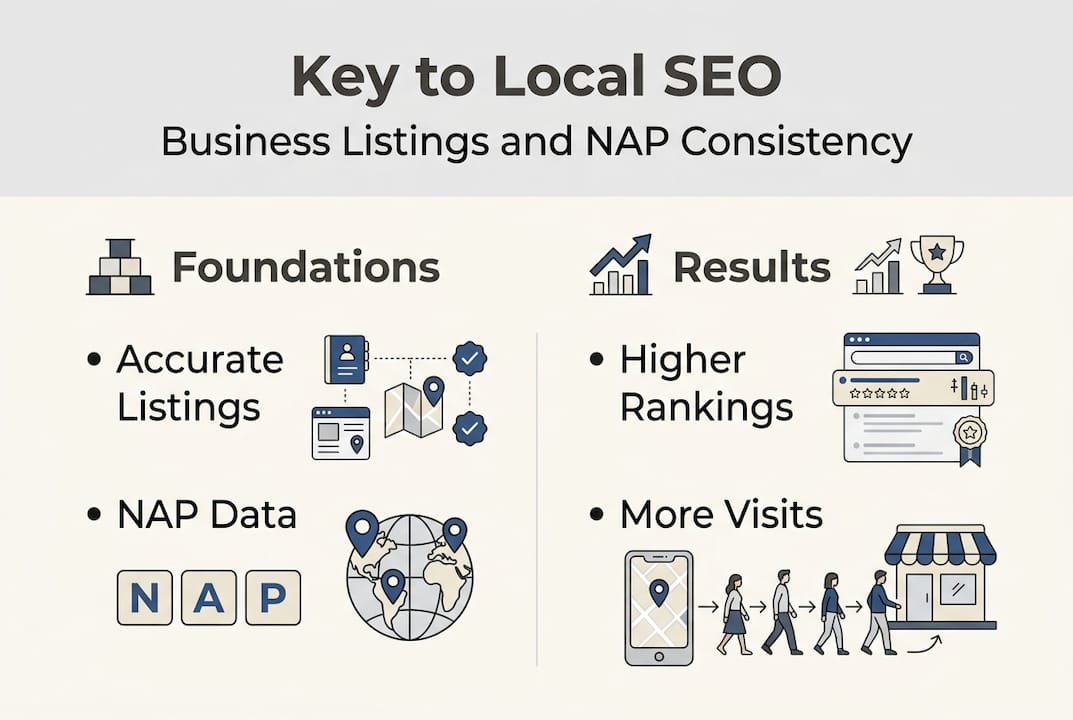
The three core data points, your Name, Address, and Phone number, are collectively known as NAP. NAP consistency means that every listing across every platform shows exactly the same details. Even small discrepancies, such as “St” versus “Street” or a missing postcode, can confuse search algorithms and undermine your rankings. NAP consistency is directly linked to higher local search rankings.
GBP is the gold standard. It’s the listing that populates Google Maps, the local pack (the three businesses shown prominently above organic results), and the Knowledge Panel. Every other citation you build should mirror your GBP details precisely. Think of GBP as your master record, and every other listing as a copy that must match it.
Here’s a quick comparison of the major listing platforms available to UK businesses:
| Platform | Best for | Ranking influence | Free tier |
|---|---|---|---|
| Google Business Profile | Local pack, Maps, Knowledge Panel | Very high | Yes |
| Yell.com | UK consumer searches | High | Yes |
| Bing Places | Bing local search | Medium | Yes |
| Apple Maps | iOS users, Siri searches | Medium | Yes |
| ThomsonLocal | UK business discovery | Medium | Yes |
| FreeIndex | UK niche sectors | Low to medium | Yes |
Google Business Profile alone carries 32% weight in rankings according to current local ranking factor data. That’s a significant slice, but it leaves 68% influenced by other signals, many of which relate directly to the quality and consistency of your wider citation profile.
Key benefits of a well-managed listing ecosystem include:
- Improved local search visibility across multiple platforms
- Stronger trust signals for Google’s ranking algorithm
- More touchpoints for potential customers to find you
- Reduced risk of competitors outranking you on directory searches
How Google Business Profile and core UK listings drive local visibility
Optimising your GBP isn’t a one-time task. It’s an ongoing effort that directly shapes where you appear in local search results. Businesses with fully optimised profiles gain 2.71 rank positions and see nearly three times the reputational benefit compared to those with incomplete profiles.
The evidence is compelling. Complete GBP profiles generate 70% more location visits and 50% more purchases than incomplete ones. That’s not a marginal gain. That’s the difference between a phone that rings and one that doesn’t.
Beyond GBP, platforms like Yell.com and ThomsonLocal carry genuine weight in UK local search. These aren’t just old-fashioned directories collecting dust. They’re actively crawled by Google, used by consumers searching for local services, and referenced by aggregator tools that distribute your data across the wider citation ecosystem.

The key difference between a managed profile and a static listing is engagement. A managed profile is kept current with updated photos, fresh posts, accurate opening hours, and active review responses. Static listings sit untouched for years, often drifting out of date and dragging rankings down with them. You can explore detailed GBP optimisation tips to understand exactly what signals Google prioritises.
Here’s a summary of how leading UK platforms influence local visibility:
| Platform | Primary signal type | Impact level |
|---|---|---|
| Google Business Profile | Proximity, relevance, authority | Critical |
| Yell.com | Citation volume, consumer trust | High |
| ThomsonLocal | Domain authority, citation | Medium-high |
| Bing Places | Cross-engine citation | Medium |
| Apple Maps | Mobile discoverability | Medium |
Three immediate wins for small businesses using GBP:
- Add at least 10 high-quality photos (interior, exterior, team, products)
- Complete every section including business description, attributes, and services
- Respond to every review within 48 hours to signal active management
If you’re ready to act on this, the GBP optimisation service at Gregg King covers all of these signals systematically.
Why NAP consistency and citation quality are crucial for SEO success
Algorithms are logical. They trust what’s consistent and penalise what’s conflicting. When your business name appears differently across listings, or your address has variations, Google interprets that as a reliability problem. The result is lower rankings and reduced visibility, often without any obvious cause.
Research shows that 94% NAP consistency correlates with top local pack rankings. Businesses that maintain rigorous accuracy across all platforms simply outrank those that don’t. And from the consumer side, inaccurate listings cause 62 to 68% of potential customers to actively avoid that business.
Quality also matters more than quantity. Twenty citations on high-authority, relevant platforms will outperform 200 spammy directory submissions every time. Prioritise platforms where your competitors appear, where your industry has a presence, and where Google actively sources structured data.
Here’s a step-by-step process for auditing your citations:
- Search your business name on Google and note every listing that appears
- Check each listing for NAP accuracy against your GBP master record
- Identify any duplicates and flag them for suppression or removal
- Update incorrect listings directly or via aggregator tools
- Document your corrected NAP in a central spreadsheet for future reference
- Submit corrected data to key aggregators such as Data Axle
Pro Tip: Use a tool like BrightLocal’s Citation Tracker to find listings you didn’t know existed. Suppressing duplicates through aggregators saves significant time and prevents conflicting data from undermining your rankings.
Addressing local SEO issues early prevents them compounding over time, which is exactly the kind of problem that becomes expensive to fix later.
Practical strategies: Audit, build and maintain business listings for UK SMBs
Once your GBP is optimised and your NAP is locked in, you can confidently expand your citation footprint. The recommended approach is to build between 10 and 20 quality citations initially, focusing on the platforms most relevant to your industry and location. Rush this process and you risk creating inconsistencies. Take it steadily and the cumulative SEO benefit is substantial.
Audit first. Before building anything new, confirm that your existing listings are accurate. Use BrightLocal or Whitespark to generate a full citation report. Fix errors before adding new platforms, otherwise you’re building on a cracked foundation.
The audit and build process should include suppressing duplicates, submitting to core aggregators, and scheduling quarterly reviews. Aggregators like Data Axle distribute your NAP data to dozens of downstream directories automatically, making maintenance far more efficient.
Embed your NAP and schema markup in your website footer. This is a simple technical step that reinforces your location signals and helps Google reconcile your on-site data with your off-site citations. You can track via BrightLocal to monitor how your citation profile evolves month to month.
Useful tools and platforms for managing UK business listings:
- BrightLocal: Full citation audit and tracking
- Whitespark: Citation building and competitor analysis
- Data Axle: UK aggregator for broad citation distribution
- Google Search Console: On-site performance monitoring
- Moz Local: Listing management and duplicate suppression
Pro Tip: Set a quarterly calendar reminder for your “SEO hygiene” session. Check for new duplicates, update seasonal hours, refresh photos, and verify that every platform still shows your correct NAP. This 30-minute routine compounds significantly over time.
For businesses ready to move beyond the basics, advanced SEO tactics can help accelerate rankings further. And if you haven’t yet set up your profile properly, the GBP setup service ensures you start on solid ground.
The real value: Quality over quantity and ongoing listing management
Here’s something the SEO industry doesn’t say loudly enough. Businesses that chase citation volume almost always plateau. They build 200 listings across low-quality directories, wonder why their rankings haven’t shifted, and then assume local SEO doesn’t work. It does work. They’re just doing it wrong.
The data backs this up. Top local pack businesses typically have fewer citations than their competitors, but those citations sit on significantly higher-authority platforms. Quality signals trust. Quantity signals desperation.
In practice, the UK businesses that outperform their sector in local search share a common habit. They treat their listings like they treat their shop front: kept clean, kept current, and regularly reviewed. Ongoing management isn’t glamorous work, but it compounds. A business that audits quarterly for two years builds an enormous structural advantage over one that set listings up once and walked away.
The mindset shift worth making is this: your listing profile is not a project to complete. It’s an asset to manage. Treating it that way, through a GBP management service or an internal process, is what separates businesses that grow from those that stagnate.
Take your local SEO further with expert support
Understanding business listings is one thing. Executing a consistent, well-managed strategy across dozens of platforms while running a business is another matter entirely.
At Gregg King, we work with UK SMBs to handle every aspect of their local search presence, from initial GBP optimisation and citation audits to ongoing GBP management solutions that keep your listings accurate and competitive. Our approach combines technical precision with practical business insight, built on over 20 years of SEO experience across diverse UK industries. Whether you need a full SEO and website design overhaul or focused listing management, we tailor every strategy to your specific goals. Get in touch for a free consultation and find out what’s holding your local rankings back.
Frequently asked questions
How many business listings should a UK SMB aim for?
Aim for 40 to 50 quality citations, prioritising core UK platforms like GBP, Yell.com, and ThomsonLocal before expanding to niche directories relevant to your industry.
Why does NAP consistency matter so much?
Search engines use NAP data to verify your business is legitimate and located where it claims. 94% NAP consistency correlates with top local pack rankings, and inaccuracies lead the majority of consumers to lose trust in your business entirely.
Can businesses improve local SEO without a Google Business Profile?
No. GBP carries 32% of local ranking weight and underpins every other local search signal. All citations should be built around a fully optimised GBP as the master record.
How often should SMBs audit their business listings?
Quarterly maintenance is the recommended standard, covering duplicate suppression, NAP accuracy checks, photo updates, and any changes to business hours or contact details.
Recommended
- Optimise your Google Business Profile for local SEO
- Why you’re not showing up for “near me” searches: 11 local SEO issues costing UK businesses high‑intent customers – Gregg King SEO
- Advanced Technical SEO Tactics to Boost Your Google Business Profile Rankings (UK Guide) – Gregg King SEO
- 12 Local SEO issues stopping UK businesses appearing for high‑intent searches (and how to fix them) – Gregg King SEO
- How to rank your salon on Google Maps for more clients
- Local SEO Services Pflugerville TX 78660 | YourLocalSEO