TL;DR:
- Organic search drives over half of small business website traffic in the UK, outperforming paid channels.
- SEO offers long-term, cost-efficient growth by building website authority without ongoing costs.
- A structured, patient approach focusing on technical, on-page, local, and off-page SEO is essential for success.
Most small business owners in the UK assume paid advertising is the fastest route to new customers. It feels logical: spend money, get clicks, see results. But this assumption is quietly costing many SMEs real growth. Organic search drives 53.3% of all website traffic, outperforming paid search, social media, and direct visits combined. That is not a marginal difference. It means that if your business is not investing in SEO, you are invisible to the majority of people actively searching for what you offer. This article explains why SEO is the smarter, longer-lasting strategy for UK SMEs, and what you can do right now to start benefiting from it.
Table of Contents
- What makes SEO a game-changer for UK SMEs
- Core SEO pillars: what every SME needs to prioritise
- SEO vs paid advertising: longevity and cost efficiency for SMEs
- Maximising SEO for UK SMEs: strategies, pitfalls, and measurable results
- Why most SMEs underestimate SEO’s power and how to break through
- Take your SEO strategy further with specialist support
- Frequently asked questions
Key Takeaways
| Point | Details |
|---|---|
| SEO drives most traffic | Over half of all website visits for SMEs come through organic search, not paid ads. |
| SEO lowers costs over time | Investing in SEO provides compounding value, lowering marketing spend compared to paid advertising. |
| Local SEO boosts leads | UK SMEs see more local customers by focusing on Google Business Profile, reviews, and local links. |
| Results take time | Meaningful SEO improvements typically take 6–12 months but deliver lasting impact. |
| Expert support pays off | Professional SEO guidance helps SMEs avoid mistakes and achieve sustained online growth. |
What makes SEO a game-changer for UK SMEs
SEO, or Search Engine Optimisation, is the process of improving your website so it appears higher in search engine results when potential customers look for your products or services. Unlike a paid ad, an organic listing does not vanish the moment your budget runs dry. It earns its place through relevance, authority, and quality, and it keeps delivering traffic without a recurring cost per click.
For UK SMEs, this distinction matters enormously. A local plumber in Leeds, a boutique accountancy firm in Bristol, or a family-run bakery in Edinburgh all compete in markets where larger brands have bigger advertising budgets. SEO levels that playing field. A well-optimised website can outrank a national chain for a local search term, simply because it is more relevant to the searcher’s intent.
The data is compelling. Organic search dominates all other traffic sources, and research confirms that SEO consistently delivers measurable improvements in rankings and visitor numbers across industries. High-intent users, people who are actively searching for a solution, arrive through organic results far more than through any other channel.
“SEO is not just a marketing tactic. For SMEs, it is the foundation of sustainable online growth.”
Here is how SEO compares to other common acquisition channels for UK SMEs:
| Channel | Cost over time | Traffic quality | Longevity |
|---|---|---|---|
| Organic SEO | Low (builds over time) | High intent | Long-lasting |
| Paid search (PPC) | High (ongoing spend) | Medium to high | Stops when budget ends |
| Social media | Medium | Lower intent | Algorithm-dependent |
| Direct traffic | None | High | Requires brand awareness |
The advantages of SEO consultancy become especially clear when you consider the compounding nature of organic growth. Every piece of quality content, every earned backlink, and every technical improvement adds to your website’s authority over time. Paid ads reset to zero the moment you pause a campaign.
Key reasons SEO outperforms other channels for UK SMEs:
- It attracts users who are already looking for your product or service
- It builds brand credibility through consistent search visibility
- It delivers traffic without a cost-per-click model
- It supports every other marketing channel by improving your overall online presence
Core SEO pillars: what every SME needs to prioritise
Understanding SEO as a single activity is a common mistake. In reality, it is built on four distinct pillars, each contributing to your overall visibility in different ways. For UK SMEs, the mechanics involve on-page, technical, local, and off-page SEO, with local particularly critical for service-based or location-specific businesses.
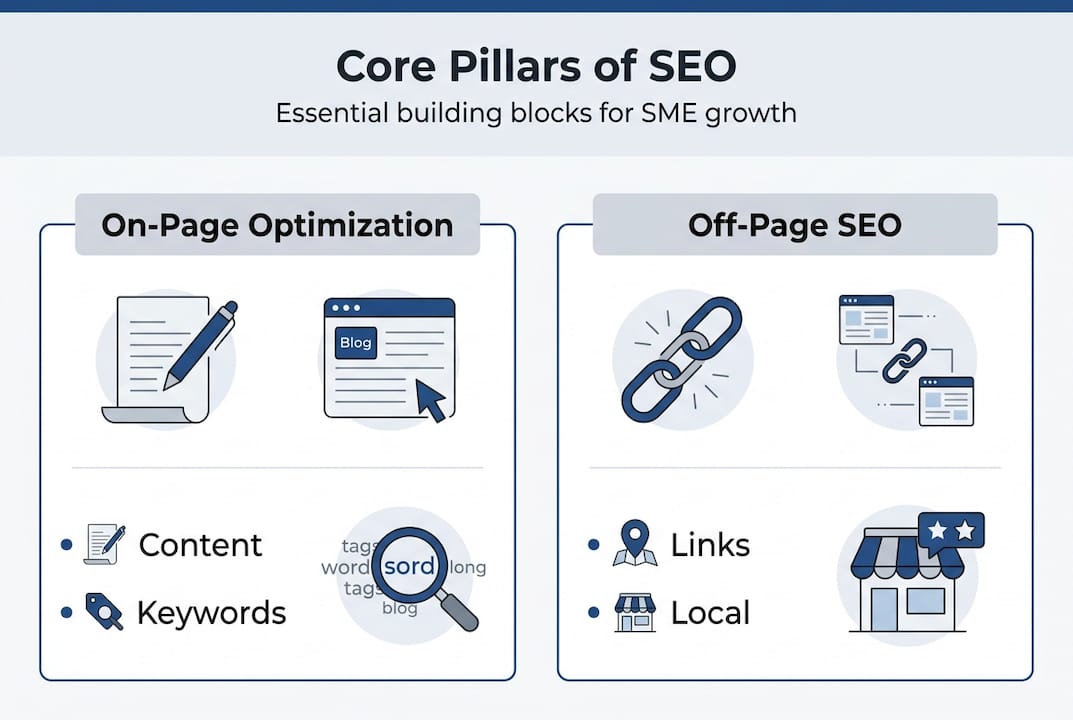
Here is a breakdown of each pillar and its impact:
| SEO pillar | What it involves | Impact for UK SMEs |
|---|---|---|
| On-page SEO | Keywords, titles, meta descriptions, content quality | Directly affects ranking for target search terms |
| Technical SEO | Site speed, mobile responsiveness, schema markup | Ensures Google can crawl and index your site correctly |
| Local SEO | Google Business Profile, citations, reviews | Critical for appearing in local map packs and nearby searches |
| Off-page SEO | Backlinks from reputable UK sources | Builds domain authority and trust signals |
Here is how to approach each pillar in a logical order:
- Fix your technical foundations first. A slow, mobile-unfriendly website will hold back every other effort. Use Google’s PageSpeed Insights to identify quick wins.
- Optimise your on-page content. Every page should target a clear search term, with a descriptive title tag, a useful meta description, and content that genuinely answers the user’s question.
- Set up and optimise your Google Business Profile. This is the single most impactful action for local visibility. Add accurate details, upload photos, and actively request reviews from satisfied customers.
- Build local backlinks. Reach out to local directories, trade associations, and community websites. A link from a trusted local source carries real weight.
Pro Tip: Do not overlook local SEO issues that silently block your visibility. Inconsistent business name, address, and phone number details across directories is one of the most common and easily fixed problems for UK SMEs.
For a structured approach to improving your rankings, top SEO strategies tailored to UK businesses provide a practical starting point. And guidance from BDC reinforces that consistent, pillar-based SEO is far more effective than sporadic, unfocused efforts.
SEO vs paid advertising: longevity and cost efficiency for SMEs
Paid advertising has its place. For a product launch, a seasonal promotion, or a time-sensitive offer, PPC (pay-per-click) campaigns can deliver fast visibility. But for ongoing customer acquisition, the economics simply do not favour paid ads for most SMEs.
The core problem is dependency. The moment you stop paying, the traffic stops. There is no residual value, no accumulated authority, and no lasting benefit. SEO works differently. Compounding SEO returns mean that improvements persist and continue reducing long-term costs, unlike paid ads which reset with every budget cycle.
Consider a realistic two-year scenario for a UK SME:
| Strategy | Year 1 cost (est.) | Year 2 cost (est.) | Traffic at end of year 2 |
|---|---|---|---|
| SEO investment | £3,000 to £6,000 | £2,000 to £4,000 | Growing, sustained organic traffic |
| PPC only | £6,000 to £12,000 | £6,000 to £12,000 | Zero traffic if budget stops |
The figures above are illustrative, but they reflect a pattern we see consistently. SEO costs tend to decrease as authority grows, while PPC costs remain flat or increase due to rising competition for ad placements.
Pro Tip: Be cautious of any provider promising guaranteed first-page rankings within weeks. Legitimate SEO takes time to build. Shortcuts, such as buying low-quality backlinks or stuffing pages with keywords, can result in Google penalties that are far more costly to recover from than simply investing properly from the start. Avoid the SEO pitfalls that catch out so many UK small businesses.
The compounding nature of SEO also means that every month of consistent effort builds on the last. A well-optimised page written today may continue attracting visitors for years, with no additional spend required.

Maximising SEO for UK SMEs: strategies, pitfalls, and measurable results
Knowing that SEO works is one thing. Knowing how to make it work for your specific business is another. Here is a practical framework for UK SMEs starting or improving their SEO efforts.
Step-by-step approach to building SEO momentum:
- Audit your current website. Identify pages with thin content, broken links, or missing meta descriptions. Free tools like Google Search Console show exactly where your site is underperforming.
- Research keywords your customers actually use. Think in terms of questions and local intent. “Emergency boiler repair Manchester” is more valuable than “boiler repair” for a local business.
- Create genuinely useful content. Answer the questions your customers ask. Blog posts, service pages, and FAQs all contribute to your topical authority.
- Earn reviews consistently. Google treats reviews as a trust signal. A steady stream of genuine, positive reviews strengthens both your local rankings and your conversion rate.
- Monitor your rankings and traffic monthly. Use Google Analytics and Search Console to track what is working and where to focus next.
On the subject of timelines, SEO results typically take 6 to 12 months to become significant. This is not a flaw. It reflects the fact that genuine authority cannot be faked or rushed. And a meta-analysis confirms that SEO significantly increases rankings and traffic, with an effect size of d=1.049, placing it in the high-impact category.
One area that is rapidly growing in importance is EEAT: Experience, Expertise, Authority, and Trust. As AI-powered search tools reshape how results are displayed, Google is placing greater weight on content that demonstrates genuine knowledge and credibility. For SMEs, this means showcasing real expertise on your website, not just keyword-optimised filler.
Pro Tip: Regularly updating your website SEO strategies and keeping pace with advanced SEO strategies for 2026 will keep your business ahead as search algorithms continue to evolve.
Key pitfalls to avoid:
- Ignoring mobile optimisation (over 60% of UK searches now happen on mobile devices)
- Publishing content without a clear keyword focus
- Neglecting your Google Business Profile
- Chasing quick wins from low-quality link-building services
Why most SMEs underestimate SEO’s power and how to break through
Here is the uncomfortable truth: most UK SMEs undervalue SEO not because it does not work, but because the results are not immediate. Paid ads feel satisfying. You spend £500, you see clicks, you feel productive. SEO asks you to invest now and trust the process for months before the full return becomes visible.
This is where most small businesses lose patience and switch back to ad spend. They abandon a strategy that was quietly building momentum, and reset to a cycle of dependency on paid traffic that never truly compounds.
In our experience, the businesses that commit to expert SEO consultancy and maintain consistent effort over 12 to 18 months almost always outperform competitors who rely solely on paid channels. The compounding effect is real. A competitor who starts SEO six months before you will be significantly harder to displace by the time you decide to begin.
The businesses that win at organic search are not necessarily the ones with the biggest budgets. They are the ones with the most patience, the most relevant content, and the most consistent approach. That is genuinely achievable for any UK SME willing to commit.
Take your SEO strategy further with specialist support
If the strategies covered here feel like a lot to manage alongside running your business, you are not alone. Most SME owners have neither the time nor the technical background to implement and maintain a full SEO programme without support.
At Gregg King, we offer tailored SEO and website design services built specifically for UK small and medium-sized businesses. From Google Business Profile optimisation to full technical and content SEO, every service is designed to generate measurable results. If you want to understand exactly what working with a specialist looks like, explore the SEO consultant benefits and see how a focused, experienced approach can accelerate your growth without the guesswork.
Frequently asked questions
How long does SEO take to see results for UK SMEs?
Most UK SMEs should expect meaningful SEO results within 6 to 12 months of consistent, well-directed effort. Starting earlier gives you a compounding advantage over competitors who delay.
Is SEO more cost-effective than paid ads for small businesses?
Yes. Compounding SEO returns mean your long-term cost per visitor decreases over time, whereas paid ad costs remain constant or increase as competition for placements grows.
What are the most important local SEO tactics for UK SMEs?
Optimising your Google Business Profile, building consistent local citations, and actively collecting genuine customer reviews are the three most impactful actions for local search visibility in the UK.
Can small business owners handle SEO themselves?
Basic SEO tasks are manageable with the right guidance, but avoiding low-quality providers and building genuine authority typically requires professional input to achieve the best and most sustainable results.